
Most people lose focus long before their body gets tired. The mind wanders, doubt creeps in, and a workout or a workday falls apart from the inside. Thought observation strategies fix that by teaching you to notice what your mind is doing before it derails you, which is the fastest way to boost your performance without changing anything physical first.
In my coaching work, the athletes and clients who perform best are not the ones with the fewest distracting thoughts. They are the ones who notice a distracting thought fast and get back on track. That skill is trainable, the same way a jump shot or a squat is trainable.
Below are 20 thought observation strategies, grouped by what they actually help you do. One honest note first: these build a mental skill. They are not a substitute for therapy if stress or anxiety is running your life.
Table of Contents
What Thought Observation Actually Means
Thought observation is simple to describe and hard to do. You notice a thought without judging it or fighting it. You just see it, name it, and decide whether to act on it.
That last part matters most. Most people do not control their thoughts. They react to them instantly, as if every thought were an order. Thought observation puts a small gap between the thought and the reaction. That gap is where better decisions happen.
How This Helps You Boost Your Performance
Attention is a limited resource. Every stray thought you chase is attention you are not spending on the task in front of you. Athletes call this getting out of your head. It happens in an exam room and a boardroom too, and learning to catch it is one of the simplest ways to boost your performance without adding a single extra rep or extra hour of work.
Mindfulness-based practice is one of the core thought observation strategies. It has real research behind it. It can help you stay present and manage stress, according to NIH News in Health. None of this requires hours a day. A few focused minutes moves the needle more than people expect.
Build the Base Skill
These four build the raw skill behind thought observation: noticing a thought before it runs off with you. Start here if you are new to this.
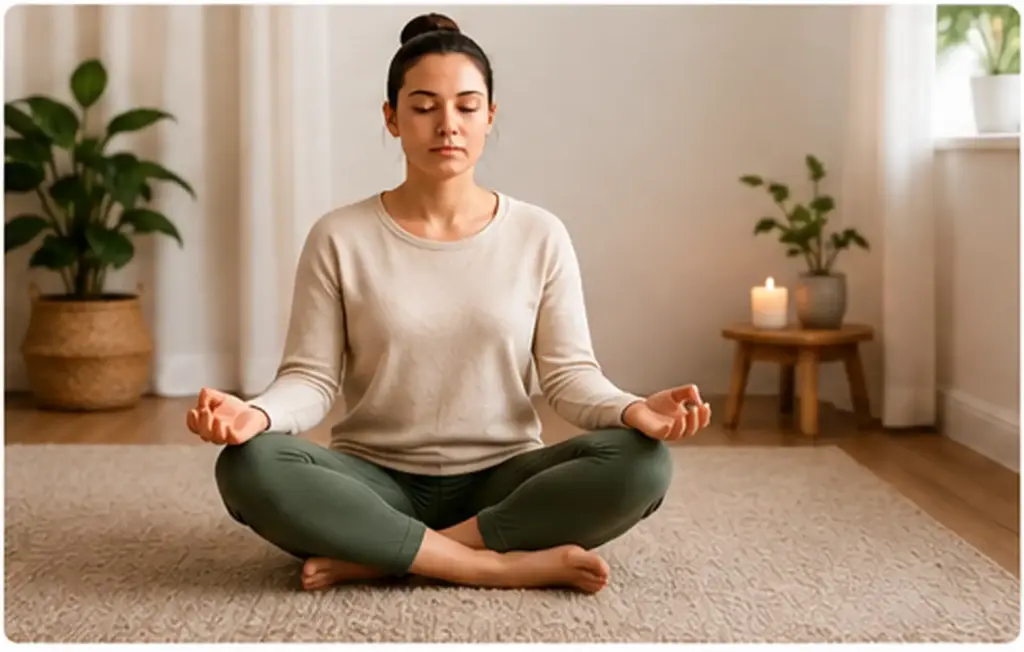
1. Practice Mindfulness to Stay Present Sit for five to ten minutes and focus on your breath. When a thought pulls your attention away, notice it, then return to your breath. You are not trying to empty your mind. You are practicing the catch-and-return, which is the actual skill.
2. Spend Time in Silence No phone, no music, no podcast. A few minutes of real silence lets you hear what your mind does when nothing else is competing for its attention. Most people avoid this because it feels uncomfortable at first. That discomfort fades with repetition.
3. Try Deep Breathing Inhale for a count of four, hold for four, exhale for four. This is not just a relaxation trick. Slower breathing gives you a physical anchor to return to while you watch your thoughts. That anchor is what makes the whole practice easier to sustain. Our pre-workout mindset guide covers a similar breathing pattern used right before training.
4. Notice Your Inner Voice Most people have a running commentary in their head and never question it. Spend a day simply listening to yours. Is it encouraging or is it constantly criticizing? You cannot change a pattern you have not noticed yet.
Track Your Own Patterns
Once you can catch a thought, the next stage of thought observation is spotting the patterns behind it. These four build that.
5. Keep a Thought Journal Write down your thoughts each morning or night, without editing them. After a week or two, patterns show up on their own: the same worry, the same excuse, the same trigger. You cannot fix what you cannot see written down in front of you.
6. Reflect on Yourself Regularly Set aside ten minutes a week to look at what worked and what did not. This is different from journaling daily thoughts; it is a step back to review the whole week. Weekly review catches slow drifts that daily notice-taking misses.
7. Recognize Patterns in Your Thinking Some thoughts show up right before your best decisions. Others show up right before your worst ones. Once you journal and reflect for a few weeks, start sorting your recurring thoughts into those two piles. The pattern itself becomes a warning system.
8. Notice Emotional Triggers A strong emotion is a signal, not random noise. When you feel a sharp reaction, pause and ask what thought came right before it. Most emotional triggers trace back to a specific, repeatable thought once you look for it.
Reframe and Respond Better
Noticing a thought is only useful if you can do something with it. Thought observation matters most right here, in the response. These four cover that part.
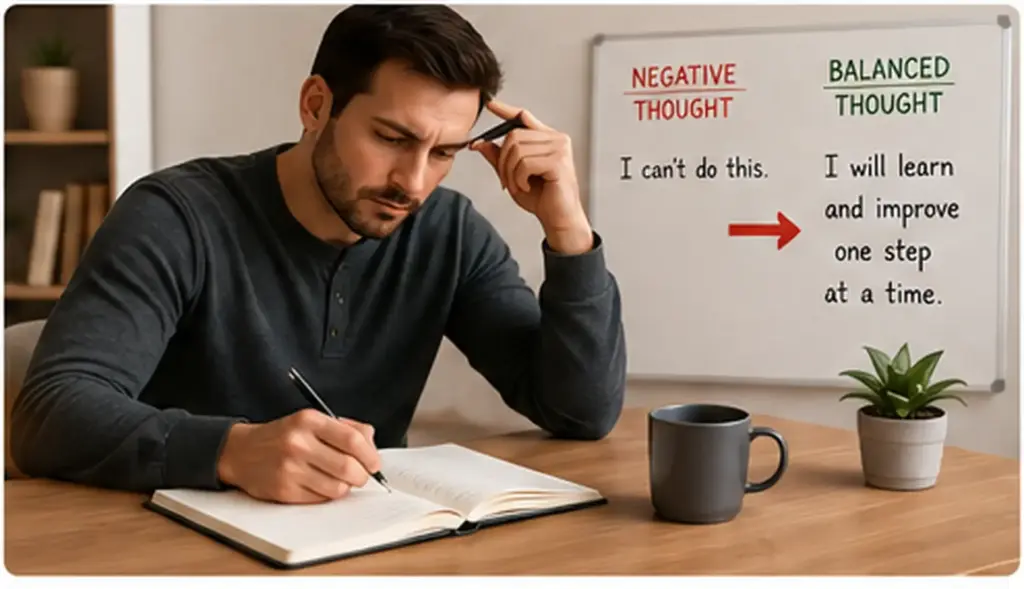
9. Challenge Negative Thoughts When you catch a harsh self-judgment, ask if you would say it to a teammate or a friend. If not, it is worth rewording. This is not about forced positivity. It is about accuracy, since harsh self-talk is rarely a fair account of what happened.
10. Pause Before Reacting A few seconds of pause before you respond to stress gives your slower, rational thinking a chance to catch up. Your fast emotional reaction fires first. The pause is what lets the smarter response arrive. In practice, this can be one deep breath before you answer.
11. Change the Way You Look at Problems A setback and a lesson are often the same event, described two different ways. When something goes wrong, ask what it taught you before you decide how you feel about it. The event does not change. Your read on it does.
12. Question Your Assumptions Notice when you are treating a guess as a fact. “They’re annoyed with me” is an assumption, not something you observed directly. Asking “is this something I know, or something I’m assuming” catches a surprising number of thoughts that do not hold up.
Build Forward Focus
These four point your attention at what is ahead instead of what already happened.
13. Use Visualization Techniques Spend a few minutes picturing yourself succeeding at something specific. A lift, a presentation, a hard conversation, anything real. Visualization works best when it is detailed, not vague. See the room. Hear the sounds. Feel the effort.
14. Set Goals for Your Day A clear target for the day gives your thought observation something to check itself against. If a thought pulls you away from the goal, that mismatch is obvious. Without a stated goal, distraction just feels like a normal thought like any other. Our goal-setting guide breaks this down further if daily goals are new to you.
15. Focus on One Thought at a Time Multitasking is mostly an illusion; you are just switching fast and losing a little focus each time. When you notice your mind splitting across two things, pick one and let the other go until you are done. Single-tasking is a skill, and thought observation is what lets you catch the split before it costs you.
16. Set Mental Boundaries Decide in advance when you check email or social media. Treat everything else as off-limits. Boundaries cut down the number of thoughts competing for your attention. That makes the rest of this list easier to practice.
Sustain a Resilient Mindset
The last four keep your thought observation going over weeks and months, not just in a single session.
17. Be Grateful Write down three specific things you are glad for each day. Gratitude is not about ignoring problems. It is about making sure your thought observation notices the good along with the bad, since most minds default to scanning for threats first.
18. Practice Patience Small, low-stakes moments are good practice. A slow line, a delayed reply, a red light. These let you notice frustration as it starts, before it takes over. The skill you build in small moments is the same one you need in big ones.
19. Talk to Yourself Positively Swap “I can’t do this” for “I haven’t figured this out yet.” The goal is not blind optimism. It is language that keeps you working the problem instead of shutting down. Stress eating is one common reaction to that kind of shutdown. Our nutrition strategy guide has practical ways to break that specific pattern.
20. Borrow From Cognitive Behavioral Techniques Cognitive behavioral therapy is a real, structured treatment. You do it with a licensed therapist, not from a blog post, says Mayo Clinic. What you can borrow on your own is the core idea. Notice the thought. Ask if it is accurate. Try a more balanced version instead. If anxiety or negative thinking is running your life, a real CBT therapist will help far more than any list of tips.

Frequently Asked Questions
What is thought observation, in plain terms? It is noticing your thoughts without immediately reacting to them. That small pause is what lets you choose a response instead of running on autopilot.
How long before I notice a difference? Most people notice something within one or two weeks of daily practice, even at five minutes a day. The skill builds gradually, similar to how strength builds with consistent training. You do not need all 20 strategies to boost your performance, just the two or three that fit how you already work.
Do I need to journal every single strategy on this list? No. Pick two or three that fit your life and stick with those for a month before adding more. Trying all 20 at once is a fast way to abandon all 20.
Can this replace therapy for anxiety or depression? No. These strategies build a useful mental skill. They are not clinical treatment. If anxiety, depression, or intrusive thoughts affect your daily life, talk to a licensed therapist or your doctor. Thought observation can support that work. It cannot substitute for it.
Is this the same as meditation? Related, but not identical. Meditation is usually its own dedicated practice with a set format. Thought observation is a skill. You can use it any time, including during a workout, a meeting, or an argument.
What is the single best strategy to start with? Start with the thought journal. It takes no real skill, just honesty. Within a week it will show you which of the other 19 strategies actually matter for your own patterns.
Conclusion
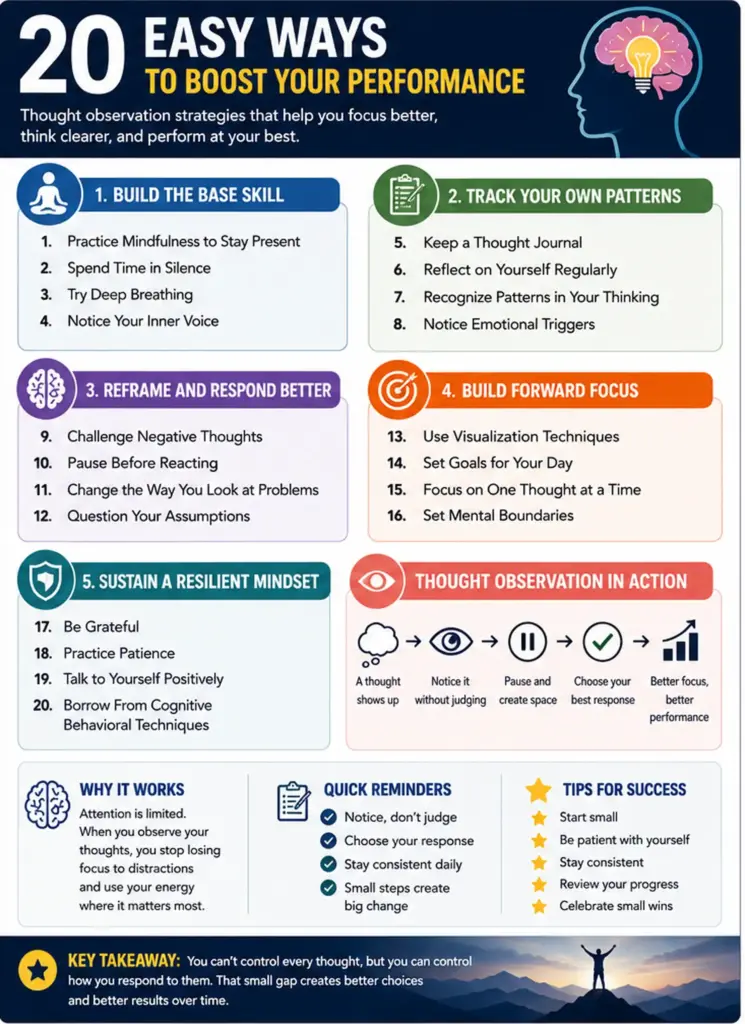
Thought observation strategies are not about controlling every thought you have. Nobody manages that. They are about building a small gap between a thought and your reaction to it, so you get to choose more often instead of reacting by default. That small gap, repeated daily, is what actually helps you boost your performance over time.
Pick two strategies from this list. Use them for the next two weeks before adding a third. That is a far better path to results than trying to run all 20 at once. If stress is a big part of what is pulling your focus, our mental health and wellbeing guide covers that ground in more depth.
Not medical advice: This content, and any calculator results on this site, are for general informational purposes only and are not a substitute for professional medical advice, diagnosis, or treatment. Always talk to a qualified healthcare provider before starting a new diet, exercise routine, or health program.
Related Articles You May Like