How do you balance mental health when life feels like too much? Most advice sounds the same: drink water, get sleep, think positive. None of that is wrong. But it skips one big thing. It skips why these habits work, and when they don’t.
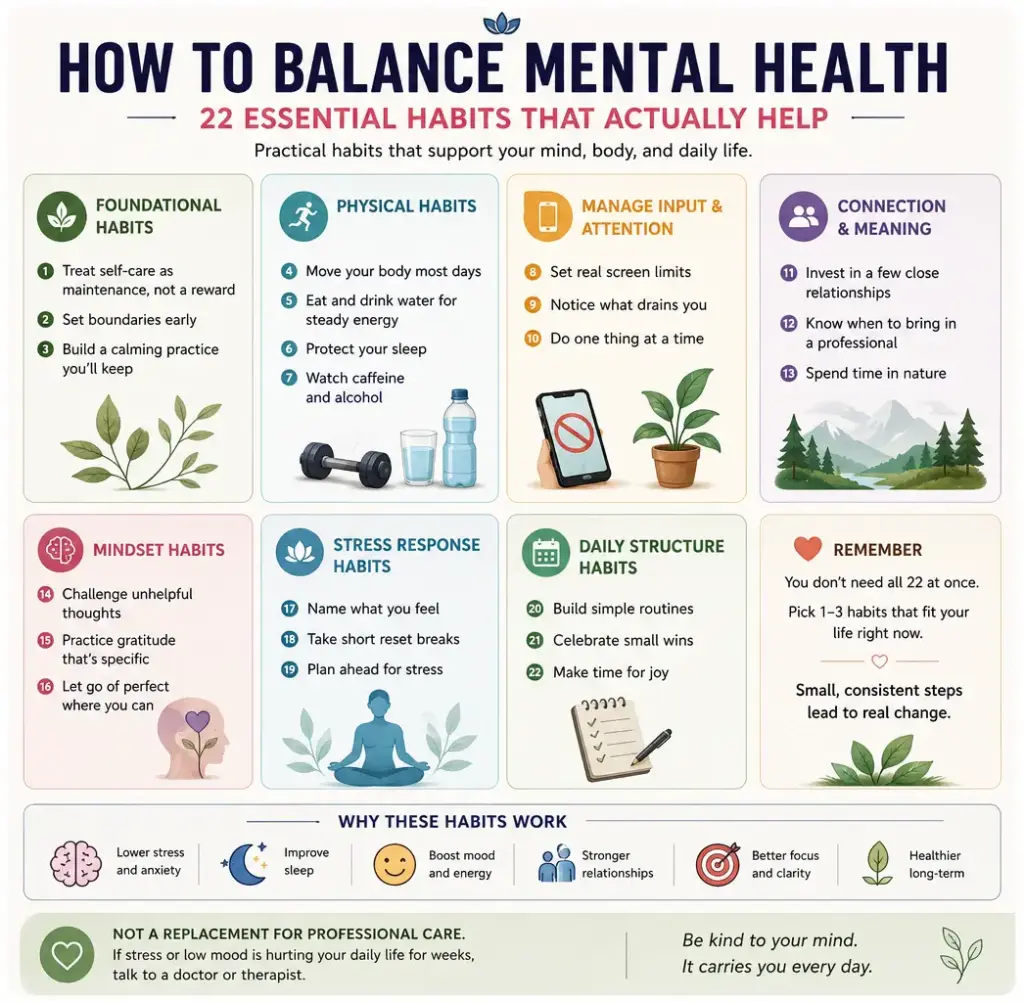
A habit that helps one person may do nothing for someone else. Someone stressed from overwork needs different tools than someone stressed from loneliness. The 22 habits below are grouped by what they actually fix. Each one comes with a short reason why it works. That way, you can pick what fits your life, instead of trying to do all 22 at once.
None of this replaces professional care. If stress or low mood is hurting your daily life for weeks at a time, talk to a doctor or a therapist. A blog post can’t do what they do. What follows can help you balance mental health day to day. It’s not a treatment for a diagnosed condition.
Table of Contents
Foundational Habits to Balance Mental Health
1. Treat self-care as maintenance, not a reward. Most people wait to rest until they’ve earned it. They finish every task first, then relax. That plan backfires, because the task list never really ends. Try scheduling self-care ahead of time, the same way you’d book a dentist visit. Don’t wait for spare time that never shows up. Small habits like this are what actually help you balance mental health over months, not just on a good day.
2. Set boundaries early. Boundaries often fail because people wait too long to set them. By the time they speak up, they’re already worn out. The words come out sharp, or too apologetic. Decide your limits before you’re pushed past them. It’s much easier to hold a line calmly when you’re not already at your limit.
3. Build a calming practice you’ll keep. Meditation, deep breathing, and guided imagery all do a similar job. They slow your breathing and shift your focus away from stress. The exact method matters less than you’d think. What matters is doing it often. Five minutes a day beats a 30-minute session you try once and quit.

Physical Habits to Balance Mental Health
4. Move your body most days. Health guidelines suggest 150 minutes of activity a week. But you’ll feel a mood lift with much less than that. A short walk can shift your mood within the hour. It won’t undo a missed workout, and it doesn’t need to. Small, steady effort beats occasional bursts you can’t keep up. The CDC links regular movement to lower anxiety and better sleep.
5. Eat and drink water for steady energy. Skipped meals and sugar crashes can feel a lot like anxiety: shaky hands, a short temper, trouble focusing. Eating on a steady schedule, with some protein at each meal, smooths that out. Mild dehydration adds fog and fatigue on top of it. Water matters more than most people think. For meal ideas that keep energy steady, this high-protein meal prep guide is a good place to start.

6. Protect your sleep. Most adults need seven to nine hours of sleep a night, according to the CDC. But the time you go to bed matters almost as much as the total hours. A different bedtime every night confuses your body’s clock. That shows up as grogginess, even after a full night’s sleep. Few habits do as much to balance mental health as a steady sleep schedule.

7. Watch caffeine and alcohol. Caffeine can make anxiety worse in people who already feel anxious. Alcohol feels relaxing at first. But it breaks up the sleep stages your brain needs to reset your mood. Neither has to disappear from your life. Just cut back during a genuinely hard week, instead of leaning on them harder.
Manage Input and Attention to Balance Mental Health
8. Set real screen limits. Screens aren’t the real problem. What they replace, and what they trigger, is the real issue. Scrolling before bed delays sleep. It often ends on something that raises your heart rate right when you’re trying to relax. One simple fix: charge your phone outside the bedroom.
9. Notice what drains you. This applies to people and to information. Maybe it’s a friend who leaves you anxious after every call. Maybe it’s a news habit that has you checking your phone every hour. You don’t need to cut either one out completely. Just noticing the pattern is the first real step.
10. Do one thing at a time. Multitasking doesn’t save time. It splits your focus and makes each task take longer. It also feels more stressful than doing one thing well. Save single-tasking for anything that needs real focus, or anything you’re already stressed about. You don’t need it for folding laundry while a podcast plays.
Connection and Meaning: A Bigger Part of How You Balance Mental Health
11. Invest in a few close relationships. Being social helps your mental health, but not in the way most people assume. Depth beats headcount. A couple of people you can be fully honest with matter more than a wide circle of casual friends. If your social life feels thin, start by reaching out to one person often, instead of trying to build a whole new circle at once. Real connection is one of the fastest ways to balance mental health during a hard stretch.
12. Know when to bring in a professional. Therapy isn’t only for emergencies. Plenty of people use it during ordinary hard stretches, long before things fall apart. If therapy isn’t within reach right now, a support group built around a specific issue, like grief or parenting, can offer some of the same value.
13. Find one hobby with no goal attached. Most “relaxing” hobbies still carry a goal. Exercise is for fitness. Reading is for learning. Cooking is for eating well. That’s fine, but it’s worth having one activity you do purely because you enjoy it. No outcome. No self-improvement angle. Just enjoyment.
14. Get outside often. Time outdoors is tied to lower stress, and you don’t need a big hike to get it. A short walk in a park, or even ten minutes sitting outside, does real work. Light, movement, and a break from indoor noise all play a part.
15. Volunteer if you have room for it. Helping others can genuinely lift your mood and give you a sense of purpose. But it backfires if it’s one more task on an already full plate. Add it once your own basics feel steady, not as a first step when you’re already struggling.
Working With Your Own Thinking to Balance Mental Health
16. Keep a loose routine. Structure makes your day predictable, which saves energy for bigger decisions. The mistake is building a routine so tight that missing one piece feels like failure. Build in some slack on purpose, so a bad day doesn’t wreck the whole plan.
17. Write to process, not to perform. Putting a vague worry into actual words makes it easier to think through. It doesn’t need to be neat, or even readable to anyone but you. The value is in getting it out of your head, not in writing something polished.
18. Be specific with gratitude. “I’m grateful for my family” doesn’t shift your mood much. It’s too vague. “I’m grateful my friend called back right when I needed to talk” does more, because it’s tied to a real moment. Mayo Clinic Health System links regular gratitude practice to better mood, sleep, and even physical health. Specific beats general every time here.
19. Set goals you can check. A vague goal like “be less stressed” gives you no way to track progress, which is discouraging on its own. Break it down. A goal like “walk 20 minutes, three times this week” gives you something to check off, and something to build on.
20. Question a negative thought before you accept it. When a thought like “I always mess this up” shows up, stop and ask if it’s actually true, or if it just feels true right now. This isn’t about forcing positive thinking. It’s about checking a claim the same way you’d check any other fact.
21. Build tolerance for imperfection. Mistakes and sudden change trigger the same discomfort: a loss of control. Trying to prevent every mistake, or resist every change, usually raises your anxiety instead of lowering it. Accepting that some things will go wrong, and that you’ll handle it when they do, tends to lower your stress more than trying to control every outcome.
22. Stay open to something new. This isn’t about one specific benefit. It’s about keeping your sense of what’s possible from shrinking over time. A new class, an unfamiliar hobby, even a different route on your regular walk, keeps you engaged with your own life instead of running it on autopilot.
FAQ: How to Balance Mental Health
Do I need all 22 habits to see results? No. Trying all 22 at once would likely backfire. Pick two or three that match what’s actually bothering you right now. Sleep and movement tend to help the widest range of people, so they’re a solid place to start.
What’s the difference between managing stress and improving mental health overall? Stress management handles one pressure in the moment, like a hard week at work. Working to balance mental health overall is bigger than that. It covers your everyday mood, your relationships, and your sense of purpose over time. Boundaries and connection tend to matter more for that bigger picture than for any single stressful day.
Can these habits replace therapy or medication? No. They support everyday resilience, and they can work alongside professional treatment. But they aren’t a substitute for it, especially for a diagnosed condition. If you’re already in treatment, mention any of these habits to your provider.
How long before I notice a difference? Sleep and movement changes often show up within a few days. Deeper habits, like setting boundaries or catching negative thoughts, usually take a few weeks of practice before they feel natural instead of effortful.
What if a habit on this list just doesn’t work for me? That’s normal. Not every habit fits every person. Gratitude journaling, for example, genuinely doesn’t click for everyone. Drop what isn’t working, and try something else on the list instead.
Where to Start When You Balance Mental Health
If this list feels like too much, that’s a sign to narrow it down, not push through all of it. Pick one habit from the physical section and one from the connection or thinking sections. Give both two or three weeks before adding anything else. Small, steady changes tend to hold up better than a big overhaul that collapses after one rough week. That’s really the whole strategy: balance mental health one small habit at a time, not all at once.
Not medical advice: This content, and any calculator results on this site, are for general informational purposes only and are not a substitute for professional medical advice, diagnosis, or treatment. Always talk to a qualified healthcare provider before starting a new diet, exercise routine, or health program.
Related Articles You May Like