Most people don’t skip workouts because they lack motivation. They skip them because the gym is closed when their schedule finally opens up. That’s the problem 24 hour fitness access was built to solve. It matters most for shift workers, parents, and anyone whose job ignores a normal 9-to-5 clock.
This guide covers what 24 hour fitness really means today. You’ll learn what it can do for your health. You’ll also learn how to build a routine that works at 5 a.m., midnight, or anywhere in between. We’ll cover the trade-offs too, because round-the-clock access solves some problems and creates a few new ones.

Table of Contents
What “24 Hour Fitness” Really Means Today
The idea took off in the early 2000s. Gym chains noticed that early-morning and evening-only hours shut out a huge share of would-be members. Shift nurses, drivers, and new parents couldn’t make a 6 a.m. to 10 p.m. window work. Key-fob entry changed that. Staff no longer had to be on-site all night. The round-the-clock gym model spread fast.
Here’s the part most guides skip. Not every gym branded around 24-hour access still runs that way. Staffing costs and safety concerns pushed several big chains to trim their hours after 2020. Some clubs that once stayed open all night now close between roughly 11 p.m. and 5 a.m. Others kept full access. A few brought it back after members asked for it.
So check before you join. Call the gym or look up its posted hours online. A brand name doesn’t guarantee round-the-clock access at every club under it. Once you know the real hours that apply to you, this guide will help you use them well.
The Real Benefits of 24 Hour Fitness Access
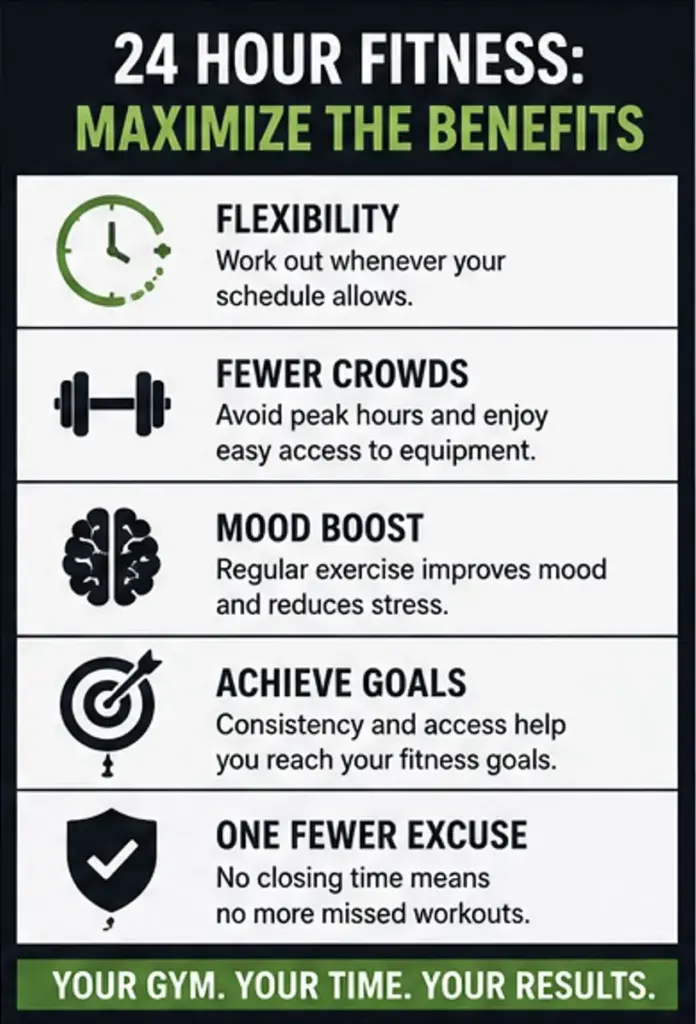
Flexibility That Matches Real Schedules
A workout plan only works if you can follow it. When a gym never closes, your training can bend around night shifts and family life. It doesn’t have to be the other way around. That kind of freedom often decides whether someone sticks with training for years. Or quits within a month because one class time clashed with picking up their kids.
Fewer Crowds, More Equipment Access
Most gyms see two sharp rushes: before work and right after it. Train during those windows and you’re fighting for squat racks with everyone else on the same clock. Shift your session even 90 minutes earlier or later. That’s often only possible with 24 hour fitness access. You can then walk straight up to open gear instead of waiting in line.
A Real, Evidence-Backed Mood Boost
Exercise isn’t just a physical outlet. Harvard Health reports that a large 2023 review pooled data from over 1,000 trials on movement and mood. It found that regular movement eased depression, anxiety, and general distress better than sitting still. Strength training showed especially strong effects on mood. A gym that’s open whenever stress hits helps here. Maybe that’s after a rough shift, or before a big meeting. Either way, you don’t have to wait until tomorrow for that lift in mood.
Room to Experiment Without a Schedule Fight
Group classes and staffed hours often force a choice. You either get the workout you want, or the time slot that’s open. Unlimited access removes that trade-off. Lift heavy on Monday. Try a longer cardio session on Wednesday. Test a new stretching routine on Friday. No class calendar required.
One Fewer Excuse
“I don’t have time” loses most of its power when the gym never closes. A rough day that ends at 11 p.m. doesn’t have to mean a skipped workout. It just means training happens later than planned. That matters far less than most people think. What matters is showing up.
How to Build a 24 Hour Fitness Workout Plan
Access alone won’t get you results. Structure will. Here’s how to turn open-door convenience into a real plan.
Set Specific, Measurable Goals First
Vague goals like “get fit” rarely survive a busy week. Decide what you’re really training for. Your goal shapes everything else, including which sessions matter most when time is tight. Working from a fuzzy plan instead of a clear one? Our guide to setting SMART fitness goals shows you how to turn “get fit” into something you can track. Our free fitness calculators can turn a goal like “lose fat” into a real daily target.
A few examples of how goals should shape your training:
- Fat loss: aim for a calorie deficit. Back it with strength work plus two or three cardio sessions a week. Strength training helps you keep muscle while you lose fat.
- Muscle gain: focus on lifting a bit more over time, and eat enough protein. Treat cardio as a smaller, backup piece.
- Endurance: build a base of steady cardio first. Add one interval session per week once that base feels solid.
Design a Balanced Weekly Split
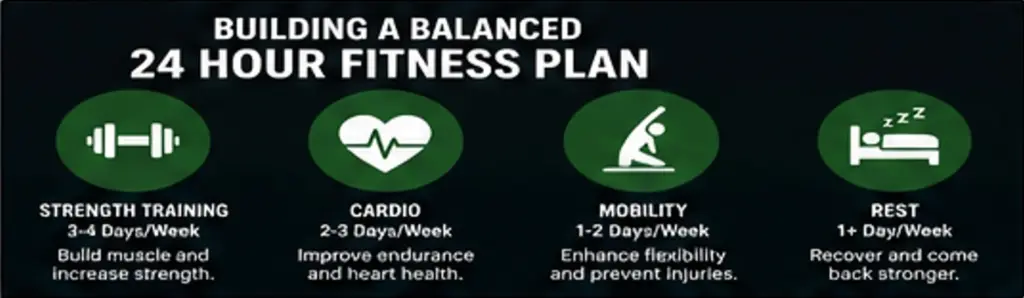
A workout plan that only covers one type of training tends to stall. A well-rounded week for most adults looks like this:
- Strength training, three to four days a week. Squats, deadlifts, presses, and rows work several muscles at once. That makes them the best choice when your gym time is short. Our strength training essentials guide covers how to order these lifts.
- Cardio, two to three days a week. The CDC’s activity guidelines set a clear target here. Adults should get 150 minutes of moderate activity a week, or 75 minutes of vigorous activity, plus at least two days of muscle-strengthening work. Mix steady cardio with shorter, harder intervals to cover both. Short on time? Our dumbbell HIIT workout guide fits a full session into 20 to 30 minutes.
- Stretching or mobility work, once or twice a week. This lowers your injury risk. It also keeps your joints moving through their full range. That matters more as your training load grows.
- Rest, at least one full day a week. Muscle rebuilds during rest, not during the workout itself. Skipping rest days doesn’t speed up progress. It usually slows it down.

Use Off-Peak Hours Strategically
Early mornings before 7 a.m. and late nights after 9 p.m. tend to be the quietest times at most clubs. Training then means less waiting and fewer distractions. That adds up to shorter, more focused sessions. Try an off-peak slot for two or three weeks before you commit to it long-term.
Get More From Gym Amenities and Staff
Round-the-clock clubs often still offer personal training and staffed classes during the day. This holds even if overnight hours run on a key fob with no one around. Book one session with a trainer to check your form on major lifts. It’s also worth reading our rundown of essential fitness equipment before you buy your own gear. One fix now can save you months of practicing a move the wrong way.
Making Non-Traditional Hours Work For Your Body
This is the part most 24 hour fitness guides skip. It might be the most useful one if you train outside a normal daytime window.
Protect Your Sleep First
Late-night or very early workouts only work long-term if they don’t eat into your sleep. The CDC’s sleep guidance says adults need at least seven hours of sleep a night. That number doesn’t change just because your workout time did. Say a midnight session pushes your bedtime past 2 a.m., and you’re up again at 7. The tiredness will eventually outweigh what the workout gave you. Treat sleep as part of the plan. Don’t trade it away just to fit training in.
Read Your Body’s Signals Instead of Ignoring Them
Your performance really does shift across the day. This isn’t just about mindset. Research on training and the body’s internal clock suggests strength tends to peak in the late afternoon and early evening. It sits lowest in the early morning. This comes down to natural swings in body heat and hormones through the day. That doesn’t make early or late training wrong. It just means your numbers may look a bit different depending on when you train. Adjust your expectations. Don’t assume something’s off with your body.
If a session feels harder than it should, pay attention to that. The same goes if your numbers keep dropping over several sessions in a row. Try shifting the workout thirty minutes earlier or later. Or swap a hard session for an easier one on a rough day. Both beat pushing through and risking an injury.

Fuel and Hydrate With Intention
Odd-hour training makes it easy to skip meals by accident. That shows up later as flat energy and slower recovery. Harvard Health offers a simple rule. Eat about 20 grams of protein within 45 minutes after a workout. Pair it with carbs if your next full meal is more than an hour or two away. A glass of milk, a protein shake with fruit, or simple eggs on toast all cover this. None of it takes much planning. For a deeper look at meal timing around training, our nutrition strategy guide walks through it step by step.
Hydration matters just as much, and it doesn’t need a complex formula. Mayo Clinic doctors keep it simple: drink to thirst instead of forcing a set amount. Too little fluid causes dehydration, and too much can cause its own problems, including low blood sodium. Keep water within reach during your session. Let thirst be your guide.
Think About Safety, Not Just Convenience
An empty gym at 2 a.m. feels peaceful. It can also mean no one nearby if something goes wrong. A few small habits lower that risk without much effort.
- Tell someone your rough workout window if you train alone overnight.
- Park in a lit area, and walk to your car with your keys ready.
- Keep your phone charged and within reach during your session.
- Skip your heaviest lifts on nights when the gym floor is empty and no staff are on-site.
- Learn where the nearest staffed hours are, in case you ever need help fast.
None of this should scare you off overnight training. Millions of people do it safely every week. It just deserves the same planning you’d give any other part of your routine.
Common Mistakes People Make With Round-the-Clock Gym Access
Unlimited access creates a few common traps worth naming directly.
- Training at the same odd hour every day with no break. Consistency matters, but so does one full rest day, no matter what hour you train.
- Assuming a “24 hour fitness” name guarantees 24-hour access. Hours vary and change over time, so check with your own gym.
- Skipping meals around odd-hour workouts because nothing feels “open.” Pack a simple snack or shake ahead of time. A late session shouldn’t mean an empty stomach.
- Chasing overnight sessions just for the empty gym floor. If a quiet gym costs you two hours of sleep, that trade usually isn’t worth it.
- Never using the staffed daytime hours at all. Even one form check from a trainer can fix problems that training alone won’t catch.
Is a 24 Hour Fitness Membership Right for You?
24 hour fitness access isn’t the best fit for everyone. It’s worth being honest about who benefits most.
It helps most for shift workers with rotating schedules. It also suits parents who can only train after kids are asleep or before they wake. The same goes for people who simply feel sharper very early or very late. It matters less if you work a steady 9-to-5. In that case, a standard-hours gym for less money may serve you just as well. Paying extra for overnight access you’ll rarely use isn’t a great trade.
Not sure which group you’re in? Track your real workout times for two weeks with whatever gym access you already have. If a good chunk of those sessions happen before 6 a.m. or after 9 p.m., round-the-clock access is likely worth it. If they don’t, standard hours will probably work fine.
What’s Next for Round-the-Clock Training
The ease behind 24 hour fitness access is now spreading past the gym itself. Home gear, app-based coaching, and connected fitness machines give people more ways to train on their own time. None of that needs a staffed gym nearby. Still, a fully equipped gym offers a range of machines that’s hard to match at home. Wearable devices are also getting better at tracking sleep and recovery. That makes it easier to tell if an odd-hour schedule is helping you, or quietly working against you.
None of that replaces the basics in this guide. Whatever new tech shows up next, one thing stays the same. Round-the-clock access is only worth having with a real plan behind it: clear goals, a balanced week, and enough sleep and food to recover.
Frequently Asked Questions
What is a 24 hour fitness gym?
It’s a gym designed to let members train at any hour. Entry often runs through a key fob or app during hours with no staff on-site. The idea suits people whose schedules don’t match standard daytime gym hours. That said, real overnight access varies by gym and has changed at many clubs since 2020.
Are 24 hour fitness gyms actually open all night?
Some are, some aren’t anymore. Staffing and safety costs led several chains to cut back overnight hours in recent years. Other locations kept full access, or brought it back after members asked. Always check your specific club’s hours. Don’t just assume the name guarantees it.
Is it safe to work out late at night?
For most healthy adults, yes. This holds as long as you’re getting enough sleep and paying attention to how you feel. The real risks don’t come from the hour itself. They come from cutting sleep short, training alone somewhere poorly lit, or skipping food because it’s late.
How many days a week should I use 24 hour fitness access?
Most adults do well with three to five sessions a week. Mix strength and cardio, and keep at least one full rest day. The exact number matters less than showing up at whatever hour fits your life.
What should I eat before an odd-hour workout?
Try a small snack with some carbs and a little protein. Eat it 30 to 90 minutes before you train. A very large meal right before training can cause discomfort, especially in harder sessions.
Can I still take group classes with a 24 hour fitness membership?
Usually yes, during the gym’s staffed hours. Many clubs also offer recorded or virtual classes members can stream anytime. That helps fill the gap during overnight hours when live classes aren’t running.
Conclusion
24 hour fitness access solves a real problem. Standard gym hours were never built around shift work, parenting, or a schedule that changes week to week. Used well, round-the-clock access removes one of the most common excuses for skipping a workout. That means clear goals, plus enough sleep and food to back it up. Used carelessly, it can just as easily wreck your sleep. Or leave you repeating the same tired routine at 2 a.m. with no real plan behind it.
The gyms themselves have changed since the idea first took off. Not every 24-hour brand still lives up to its name at every location. Confirm the hours that apply to you. Build the routine from this guide around them. The freedom that drew you to 24 hour fitness in the first place will start paying off.
Not medical advice: This content, and any calculator results on this site, are for general informational purposes only and are not a substitute for professional medical advice, diagnosis, or treatment. Always talk to a qualified healthcare provider before starting a new diet, exercise routine, or health program.
Related Articles You May Like