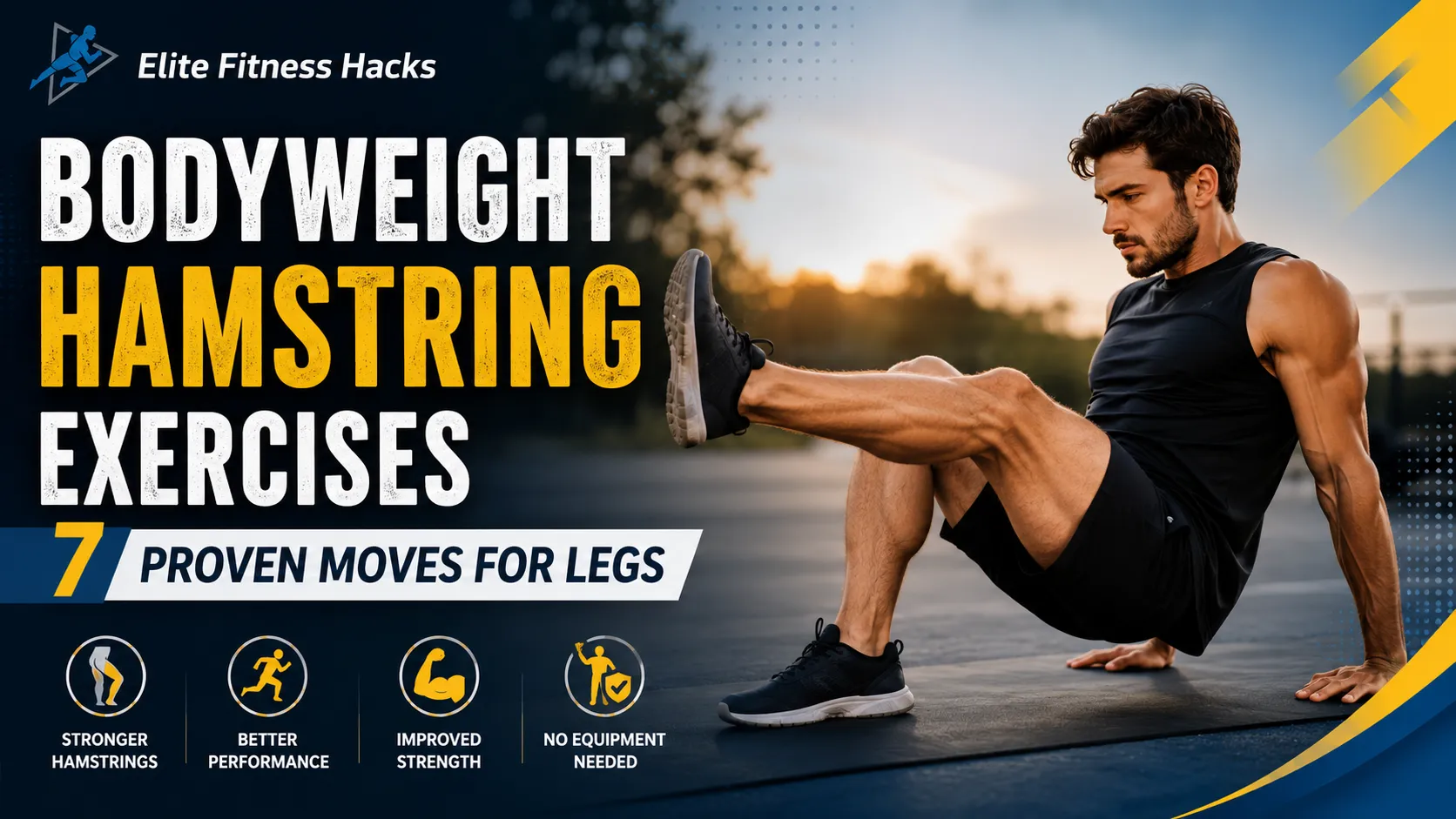
Your hamstrings do more work than most people give them credit for. They control how you decelerate when running, how well you stabilize your knees, and how balanced your legs actually look from the front and the back. Bodyweight hamstring exercises train all of that without a single piece of equipment.
In my coaching work, hamstrings are the most commonly neglected muscle group I see. Clients train quads hard, skip hamstrings, and wonder why their knees feel unstable or their sprint speed stalls. This guide fixes that with 7 real bodyweight hamstring exercises, the actual research behind why they work, and a simple plan for fitting them into your week.
If you have ever wondered why your legs feel strong in the gym but unstable on a run or a hike, weak hamstrings relative to your quads are a common, fixable reason. Bodyweight hamstring exercises are one of the most direct ways to close that gap, since several of the best options for this muscle group need no equipment at all.
Table of Contents
Why Hamstring Strength Actually Matters
Weak hamstrings are one of the most common, most preventable causes of leg injuries in sport. A 2019 systematic review in the British Journal of Sports Medicine, covering over 8,400 athletes, found that training programs including the Nordic hamstring curl cut hamstring injury rates by roughly 51%, per van Dyk et al.. Some researchers have since questioned the exact size of that effect. But the direction holds across nearly every study on the topic: stronger hamstrings mean fewer strains.
Beyond injury prevention, strong hamstrings improve how you move day to day. They drive hip extension. They control knee bending. They support your lower back during almost any bending or lifting motion. Neglect them, and your quads end up compensating for work they were never built to do alone.
Bodyweight hamstring exercises are not a lesser substitute for machines or barbells here either. The Nordic curl, the single exercise with the strongest research behind it for injury prevention, is a bodyweight movement by design. No equipment is required to train this muscle group seriously.
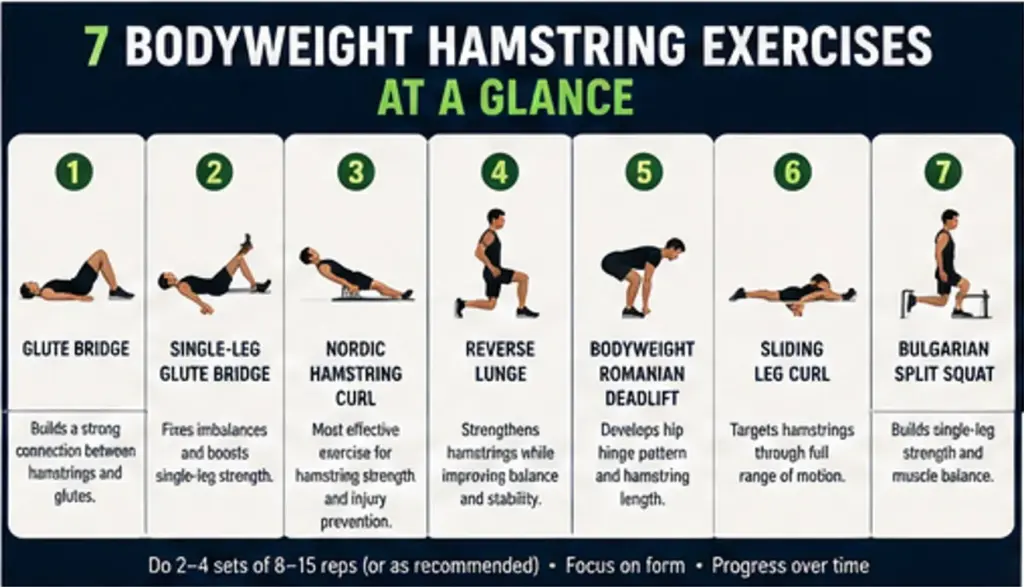
The 7 bodyweight hamstring exercises below cover a full range, from beginner-friendly to genuinely demanding. Work through them in order if you’re new to hamstring training specifically.
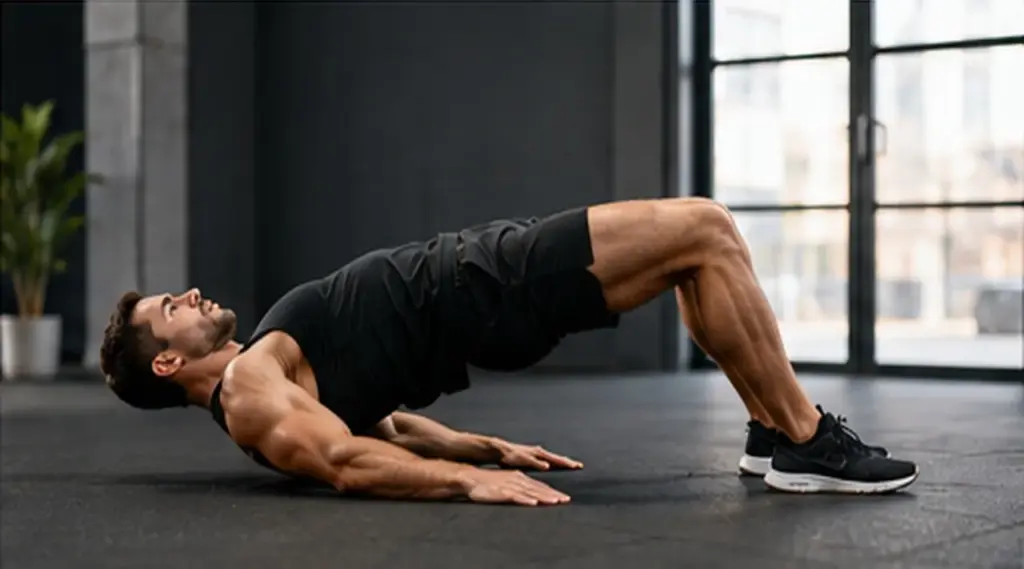
1. Glute Bridge
The glute bridge is the entry point into bodyweight hamstring exercises for a reason. It teaches your hamstrings and glutes to work together without asking much of your balance or coordination.
How to perform:
- Lie on your back with your knees bent and feet flat on the floor, hip-width apart.
- Rest your arms at your sides, palms down.
- Engage your core, then lift your hips until your body forms a straight line from shoulders to knees.
- Squeeze your glutes and hamstrings at the top, then lower back down with control.
- Do 12 to 15 reps.
Coaching notes: Most people rush the top position. Pause for a full second at the top and actually squeeze, rather than bouncing through the rep. That pause is where most of the muscle activation happens.
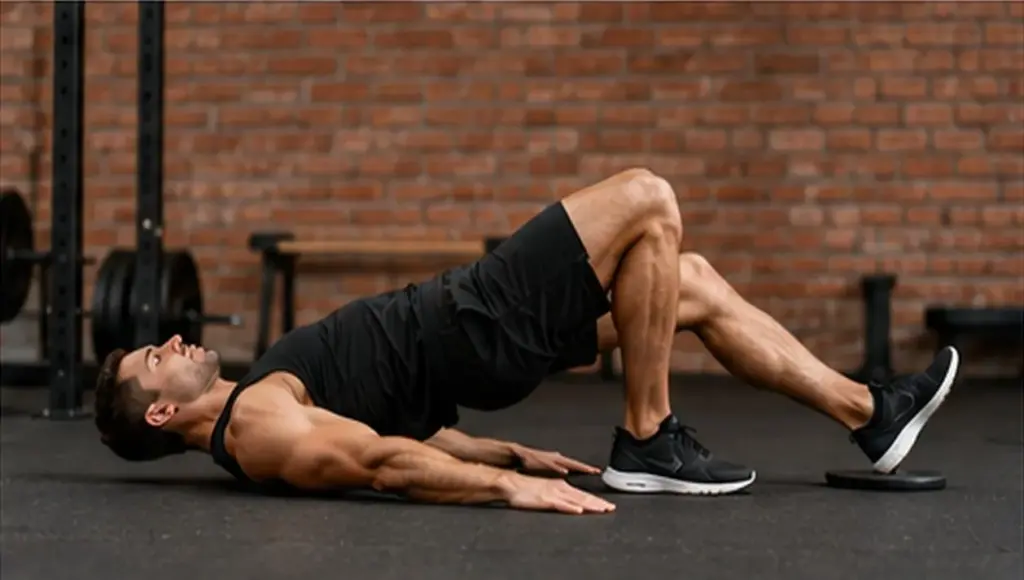
2. Single-Leg Glute Bridge
This one exposes side-to-side strength differences that the two-legged version can hide entirely.
How to perform:
- Lie on your back, one knee bent and foot flat, the other leg extended straight.
- Push through the bent-leg heel to lift your hips, keeping the extended leg in line with your torso.
- Pause at the top, squeezing the hamstring and glute on the working side.
- Lower with control. Complete 12 to 15 reps, then switch legs.
Coaching notes: If one side struggles noticeably more than the other, that is useful information, not a problem to hide. Spend extra sets on the weaker side until the gap closes.
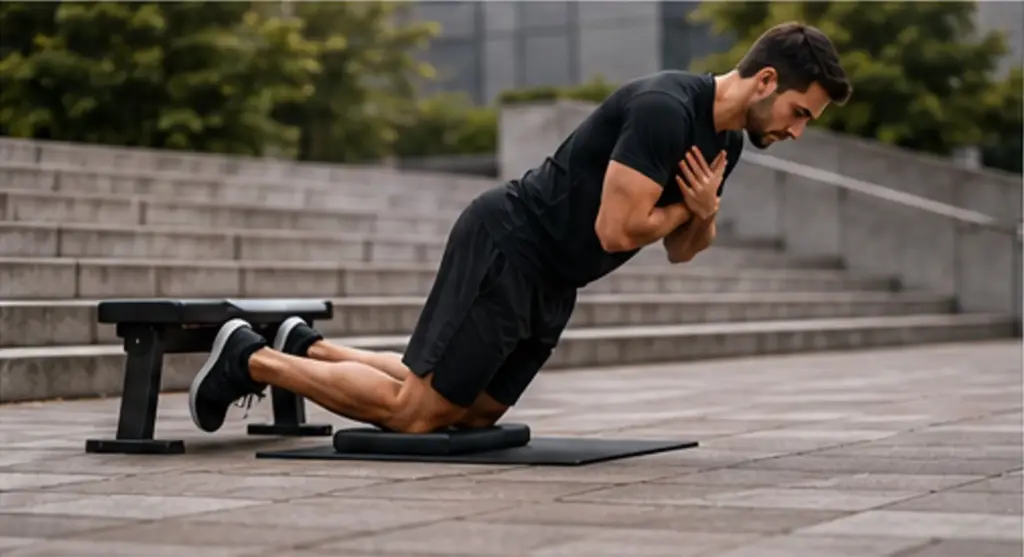
3. Nordic Hamstring Curl
This is the exercise behind the injury-prevention research mentioned earlier. It is genuinely the hardest of these bodyweight hamstring exercises. Most people, including trained athletes, cannot complete a full unassisted rep the first time they try it.
How to perform:
- Kneel on a cushioned surface with your feet anchored under something sturdy, or have a partner hold your ankles firmly.
- Keeping your body in a straight line from knees to head, slowly lower your torso toward the floor, resisting the fall as long as you can.
- When you can no longer control the descent, catch yourself with your hands and push back up.
- Aim for 6 to 10 reps, prioritizing control over speed.
Coaching notes: Do not attempt full reps on your first try. Lower yourself only as far as you can control, catch yourself, and build the range over several weeks. Going too far, too fast, is how people strain a hamstring doing the exact exercise meant to prevent that.
4. Reverse Lunge
The reverse lunge trains hamstrings and quads together, which makes it one of the more efficient moves on this list for full leg development.
How to perform:
- Stand with feet hip-width apart.
- Step backward with one foot, lowering into a lunge with your front knee tracking over your ankle.
- Push through your front heel to return to standing.
- Complete 12 to 15 reps per leg.
Coaching notes: Keep your torso upright rather than leaning forward. Leaning shifts the work toward your quads and away from the hamstrings and glutes, which defeats part of the point of including this move here.
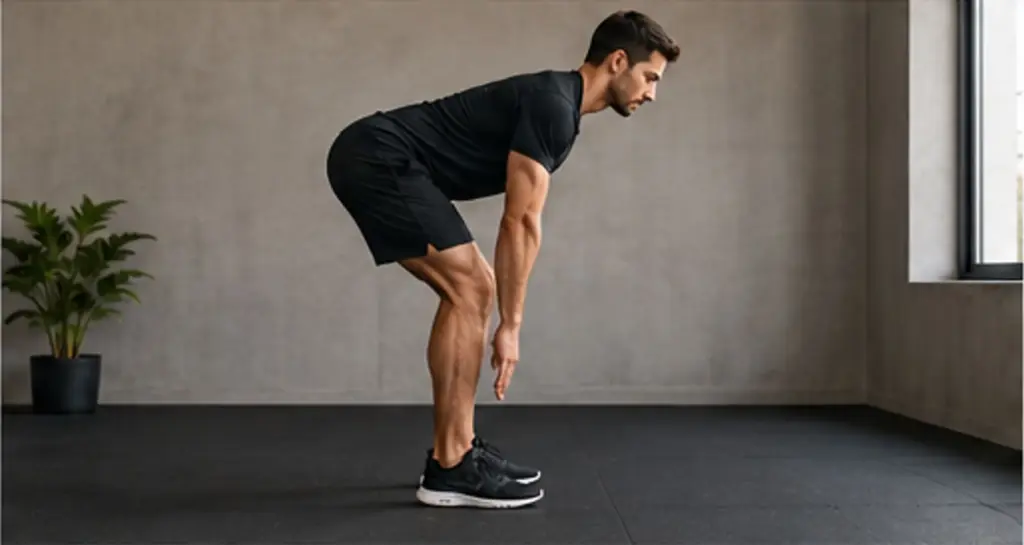
5. Bodyweight Romanian Deadlift
This version trades load for control, making it a genuinely good way to build hamstring flexibility alongside strength.
How to perform:
- Stand with feet hip-width apart, knees slightly bent.
- Hinge at your hips, keeping your back flat, and lower your torso until you feel a real stretch through your hamstrings.
- Drive your hips forward to return to standing, squeezing your hamstrings and glutes at the top.
- Perform 12 to 15 reps.
Coaching notes: This is a hip hinge, not a squat. Your knees should barely bend beyond the slight starting angle. If your knees are doing most of the work, you have turned this into a squat and lost most of the hamstring benefit.
6. Sliding Leg Curl
If you have towels or sliders, this is the closest bodyweight equivalent to a machine hamstring curl.
How to perform:
- Lie on your back with your feet on sliders or towels, legs straight, hips lifted into a bridge.
- Bend your knees to slide your feet in toward your glutes, keeping your hips elevated the whole time.
- Slide your feet back out to full extension without letting your hips drop.
- Complete 10 to 12 reps.
Coaching notes: Keeping your hips up throughout the entire movement is what separates this from a sloppy version. If your hips sag, slow down and shorten the range until you can control it properly.
7. Bulgarian Split Squat
This one is demanding on balance as much as strength, which is exactly why it belongs at the end of this list rather than the beginning.
How to perform:
- Stand a few feet in front of a bench, placing the top of one foot on the bench behind you.
- Lower into a lunge, keeping your front knee tracking over your ankle.
- Push through your front heel to return to standing.
- Complete 12 to 15 reps per leg.
Coaching notes: Most of your weight should stay on your front leg, not the back foot on the bench. The back leg is there for balance, not to share the workload.
Common Mistakes With Bodyweight Hamstring Exercises
Most of the frustration people run into with bodyweight hamstring exercises traces back to one of these five habits.
Rushing through reps. Speed hides weakness. It cheats the muscle out of real tension. Slow down, especially on the way down. That lowering portion is where a lot of the strength and injury-prevention benefit actually happens.
Letting the hips drop. This shows up most in the glute bridge, single-leg glute bridge, and sliding leg curl. A dropped hip means the hamstrings and glutes stop doing the work. Your lower back starts picking up the slack instead.
Turning hip hinges into squats. The bodyweight Romanian deadlift is a hip hinge, not a squat. If your knees are bending more than they should, you have shifted the work away from your hamstrings, which defeats the purpose of choosing this exercise in the first place.
Skipping the warm-up. Cold hamstrings strain more easily. This matters especially before something demanding like the Nordic curl. A few minutes of light cardio and dynamic stretching before training goes a long way.
Progressing too fast on the Nordic curl. This is the exercise most likely to cause a strain if you push too hard too soon. Build your range gradually over weeks, not in a single session.
Building This Into a Real Weekly Routine
Fitting bodyweight hamstring exercises into a real week comes down to frequency and progression, not doing everything at once. Two to three sessions a week is enough to see real progress, with at least one rest day between sessions for the muscle to actually recover and adapt. Cramming all 7 exercises into every session is unnecessary. It usually backfires through fatigue instead of helping.
If you’re just starting out, pick 3 exercises: the glute bridge, reverse lunge, and bodyweight Romanian deadlift. Master those before adding anything more demanding.
Once that feels manageable, add the single-leg glute bridge and sliding leg curl. Save the Nordic curl and Bulgarian split squat for last, since both demand more balance, control, and existing strength than the others.
Progressive overload still applies here even without weights. Add reps, slow down the tempo, or increase the range of motion over time rather than staying at the same difficulty indefinitely. If you want a broader structure for tracking that kind of progress, our strength training essentials guide covers how to build a full program around movements like these. Our SMART fitness goals guide is useful too if you want a structured way to track that progress over weeks and months instead of guessing.

Recovery Matters as Much as the Workout
Bodyweight hamstring exercises only build real strength if you recover properly between sessions. Muscle does not get built during the workout itself. It gets built during recovery, which means protein and sleep matter just as much as which exercises you choose. Aim to eat protein within a few hours of training, and make sure your daily intake supports the muscle you’re trying to build.
Our high protein meal prep ideas guide covers how to set that up without overhauling your entire diet, and our macro calculator can tell you roughly how much protein your training actually calls for.
Modifying Bodyweight Hamstring Exercises for Your Level
Not every exercise on this list needs to be done exactly as written. A few smart modifications make these bodyweight hamstring exercises accessible for beginners and advanced trainees alike.
If the Nordic curl feels impossible, use a resistance band looped around a sturdy anchor to assist the hardest part of the descent. This lets you build the eccentric strength gradually instead of skipping the exercise entirely because a full rep feels out of reach.
If balance is limiting your Bulgarian split squat, hold onto a wall or sturdy chair with one hand while you build confidence in the position. Balance improves with practice, and there is no benefit to wobbling through unstable reps before you’re ready.
If your knees bother you during lunges, shorten the range of motion and focus on control rather than depth. A partial rep done well beats a full rep done poorly, especially early on.
If you want more challenge without adding load, slow down your tempo instead. A four-second lowering phase adds real difficulty. No extra equipment needed.
These adjustments are not lesser versions of the exercise. They are how you actually get stronger without getting hurt along the way, which matters more than rushing toward the hardest variation before you’re ready for it.
Progress at your own pace here. Bodyweight hamstring exercises reward patience more than most people expect, and rushing past a modification before you’re ready is one of the more common ways people stall out or get hurt.
Frequently Asked Questions
Real questions people ask about bodyweight hamstring exercises, not just restated benefits from earlier in this guide.
How often should I do bodyweight hamstring exercises? Two to three times a week works well for most people, with rest days in between. More is not automatically better here. Recovery is when the actual strength gains happen.
Can bodyweight training really build noticeable muscle? Yes, especially if you apply progressive overload to bodyweight hamstring exercises specifically. Add reps, slow your tempo, or increase range of motion over time rather than repeating the exact same workout indefinitely.
What should I do if I feel pain during one of these exercises? Stop immediately. Sharp or sudden pain is different from normal muscle fatigue, and pushing through it risks turning a minor issue into a real injury. See a doctor or physical therapist if pain persists after you stop.
Do these exercises improve flexibility too? Yes, particularly the bodyweight Romanian deadlift and the Nordic curl. Both work the hamstring through a real stretch, not just a contraction. That supports flexibility over time, alongside strength.
Should I combine this with cardio? It helps, but it is not required for hamstring strength specifically. Cardio supports fat loss and general fitness, which can make toning more visible, but the strength gains from these exercises come from the resistance work itself.
Do I need any equipment at all? No. Every exercise here works with just your body weight. Sliders, towels, or a bench add variety and a bit more challenge, but none of them are required to get real results.
How long before I see results? Most people notice a difference in strength within 2 to 3 weeks. Visible changes in tone tend to show up within 4 to 6 weeks. That assumes consistent training and reasonable nutrition. Genetics and starting point both affect the exact timeline.
Which of these are best for a true beginner? Start with the glute bridge and reverse lunge. Both are straightforward to learn and still genuinely effective. Add the single-leg glute bridge and Bulgarian split squat once the basics feel controlled, not rushed.
Conclusion
Strong hamstrings protect your knees, support your lower back, and round out your leg strength in a way quad-focused training never fully covers on its own. These 7 bodyweight hamstring exercises give you a real path from beginner to advanced without needing a single piece of equipment.
Bodyweight hamstring exercises work because consistency beats intensity here. Start with 2 to 3 sessions a week, master the basics before adding the harder moves, and give recovery the same attention you give the workouts themselves. That combination, not any single exercise, is what actually builds stronger, more resilient legs over time.
Not medical advice: This content, and any calculator results on this site, are for general informational purposes only and are not a substitute for professional medical advice, diagnosis, or treatment. Always talk to a qualified healthcare provider before starting a new diet, exercise routine, or health program.
Related Articles You May Like