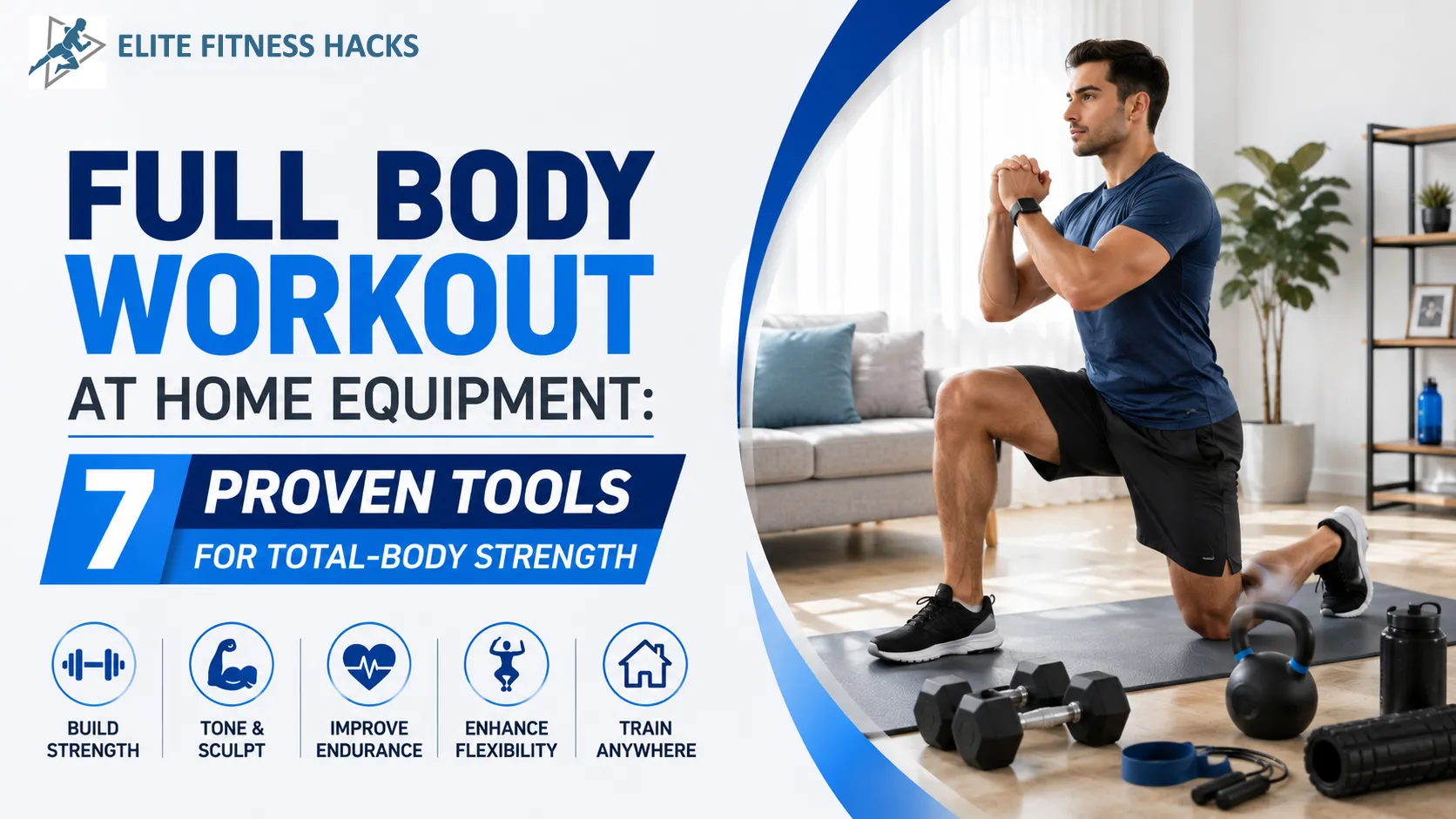
You do not need a gym membership for a full body workout at home equipment routine. Seven simple tools can train every major muscle group in under an hour. This guide covers the best tools to buy and why each one works. It also includes a ready-to-run workout and the recovery habits that make the training pay off.
Table of Contents
Why a Full Body Workout at Home Equipment Setup Works So Well
Most people who start training at home just grab whatever is nearby. They repeat it until they get bored. That builds a habit, but it rarely builds real strength.
A full body workout at home equipment setup pushes you toward a better habit. You pick tools that let you push, pull, hinge, squat, and carry. Those five moves cover almost everything your body does each day, like lifting a bag or standing up without using your hands.
The CDC has clear advice here. Adults should do muscle-strengthening activity that works all the major muscle groups at least two days a week. Aim for one to three sets of 8 to 12 reps per exercise. A full-body plan makes this easy. One session already covers your legs, back, chest, shoulders, arms, and core.
The practical perks add up fast:
- No commute. A 40-minute home session can replace a 90-minute trip to the gym and back.
- Lower cost over time. A few dumbbells and bands often cost less than one year of gym dues.
- A schedule that bends to you. Train at 6 a.m. or 9 p.m. No class times to plan around.
- Room to learn. New lifters can practice form without an audience. That matters more than most people admit.
This setup will not replace a gym for someone chasing a powerlifting record. For general strength, muscle upkeep, and fat loss, though, it is a different story. A smart full body workout at home equipment setup gets you close to what a commercial gym offers.
Full-Body Training vs. Split Routines
A split routine trains one or two muscle groups per session. Chest and triceps on Monday. Back and biceps on Wednesday. A full-body routine trains your whole body in almost every session, usually three times a week with rest days between.
Full-body training suits three types of people well: beginners still learning the moves, and people training three days a week or less. It also suits anyone with a busy, unpredictable week. Since each session covers the whole body, one missed workout will not leave a muscle group untrained for two weeks straight.
Splits make more sense once you train five or six days a week and want more volume per muscle group. That usually matters most after a year or two of steady training. New to lifting? These essentials of strength training and conditioning are worth a read before you choose a structure.
There is no single right answer here. Full-body training gives you frequency and consistency. Splits give you volume and focus. Pick the one that fits your week. For most beginners, a full body workout at home equipment approach is simpler and easier to stick with.
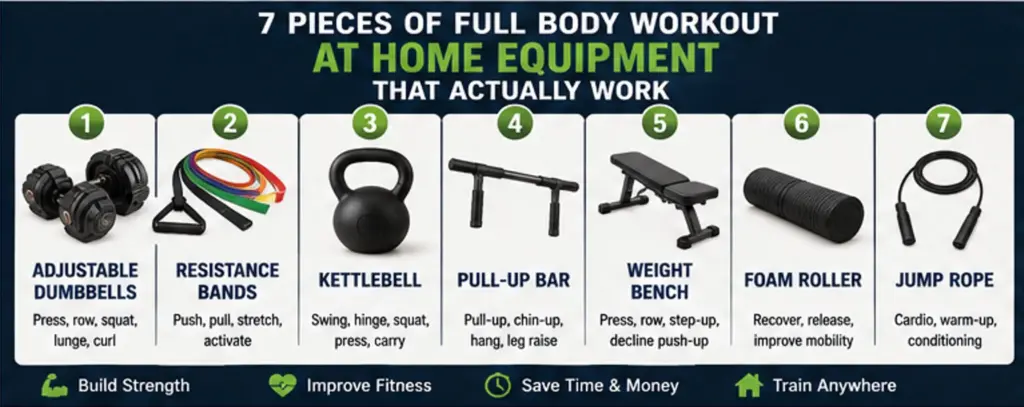
7 Pieces of Full Body Workout at Home Equipment That Actually Work
You do not need all seven items on day one. Two or three, chosen well, can carry a beginner for six months or longer.
1. Adjustable Dumbbells
Dumbbells are the most useful piece of full body workout at home equipment you can buy. One pair covers pressing, rowing, squatting, and carrying moves. Adjustable sets that go from 5 to 50 pounds take up the space of one pair. You still get the range of a full rack.
Try these moves:
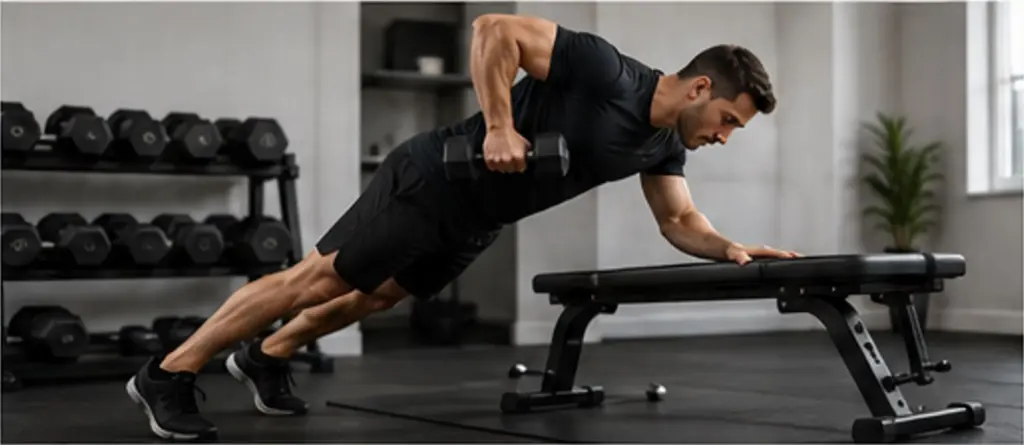
- Chest press: works the chest, shoulders, and triceps.
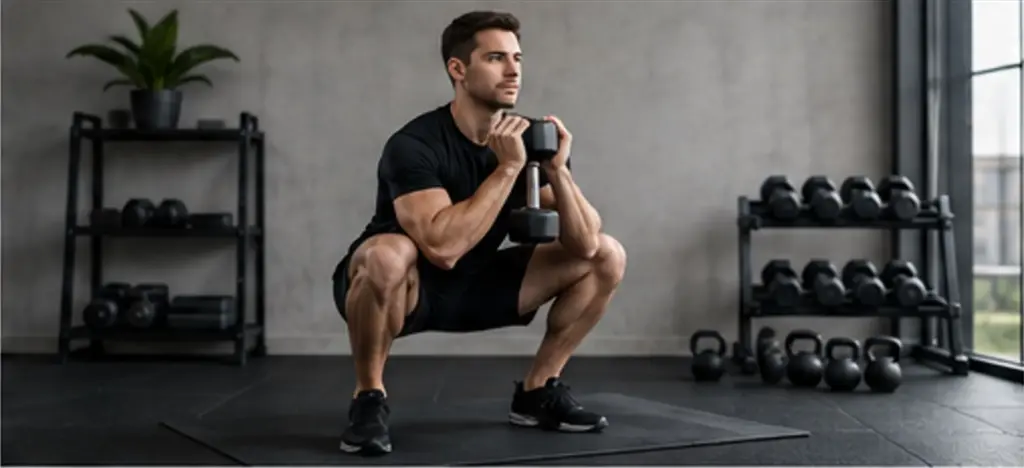
- Goblet squat: targets the quads, hamstrings, and glutes.
- Bent-over row: builds the mid-back and rear shoulders. For more on this move, see these dumbbell back exercises.
- Romanian deadlift: trains the hamstrings, glutes, and lower back.
A single fixed pair often feels heavy at first and light within a month. Adjustable dumbbells fix that. You add weight the same week your current load starts feeling easy.
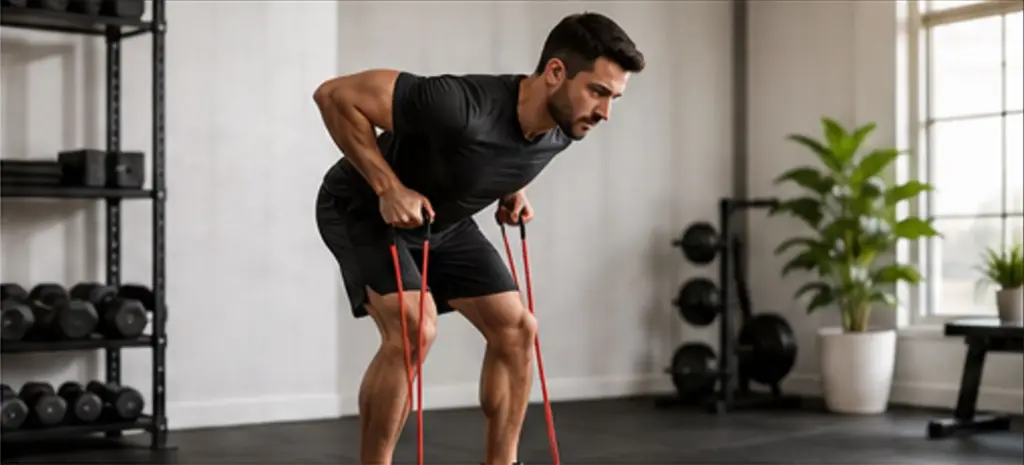
2. Resistance Bands
Bands are cheap, light, and easy to pack. A full set of five bands fits in a small bag. It often costs less than one personal training session.
Bands work well for:
- Band rows: build the upper back and rear shoulders, a spot most home routines skip.
- Band squats: add load to bodyweight squats without extra weights.
- Lateral band walks: wake up the glute muscles that stabilize your hips when you walk or run.
One warning: check bands for small tears before every session. A band that snaps under load can cause a real injury. Cheap latex bands wear out faster than braided fabric bands. Even so, bands are one of the cheapest ways to round out a full body workout at home equipment setup.
3. Kettlebells
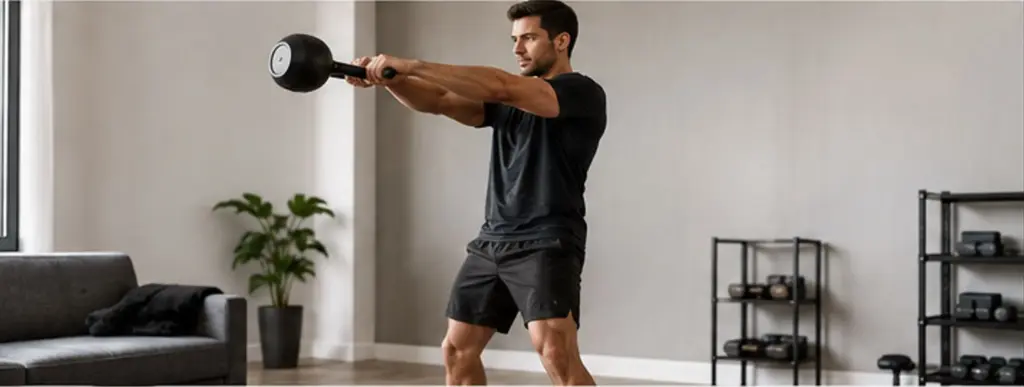
A kettlebell moves differently than a dumbbell. Its weight sits below and away from the handle. That challenges your grip and core in a way a dumbbell does not. Kettlebells shine for fast, hip-driven moves.
Core kettlebell moves:
- Kettlebell swing: a hip-hinge move that trains the glutes, hamstrings, and lower back while raising your heart rate.
- Goblet squat: works the quads and core while it teaches you to keep an upright torso.
- Clean and press: blends a hip-driven pull with an overhead press in one motion.
Kettlebell form takes longer to learn than dumbbell form, especially the swing. Watch a few short tutorials first. Start lighter than you think you need. Your lower back will thank you. One kettlebell can replace several dumbbell exercises in a full body workout at home equipment setup.
4. Pull-Up Bar
A doorframe pull-up bar trains true vertical pulling. Dumbbells and bands only come close to this pattern. A pull-up bar hits your lats, upper back, biceps, and grip in one move.
Can’t do a strict pull-up yet? That is normal. It does not mean your upper body is weak everywhere else. Loop a resistance band over the bar for support. Build toward a full rep over a few weeks.
Try these: pull-ups, chin-ups, hanging leg raises for the core, and dead hangs. Dead hangs build grip strength and gently stretch your spine after a day at a desk. A bar like this earns a spot in almost any full body workout at home equipment plan.
5. Yoga Mat
A mat is easy to skip on a shopping list, but it matters. It makes floor work possible without sore knees, sore elbows, or a slippery surface during planks. Half-inch mats hold up better than thin yoga mats over time.
The mat supports core and mobility work: planks, mountain climbers, glute bridges, and stretches during your cool-down. None of these need loaded weight. That makes the mat useful even on days when your joints need a lighter session. It still earns its spot in any solid full body workout at home equipment setup.
6. Stability Ball
A stability ball adds wobble to otherwise steady exercises. That wakes up small stabilizing muscles around your core, hips, and shoulders. Ball crunches and hamstring curls are the two most common uses. The ball also works for supported dumbbell chest presses when you have no bench.
Buy a ball sized to your height. A 55 cm ball fits most people between 5’1″ and 5’7″. Taller users should pick 65 cm. The wrong size changes the angle of every move you do on it.
7. Jump Rope
Most equipment lists skip the jump rope, and that is a mistake. A rope warms up your whole body in under three minutes. It raises your heart rate faster than jogging in place. It also takes up almost no storage space.
Three minutes of rope work before a strength circuit primes your joints and nervous system better than static stretching alone. It also works as a standalone cardio session on rest days from lifting. It pairs well with the interval style used in dumbbell HIIT workouts.
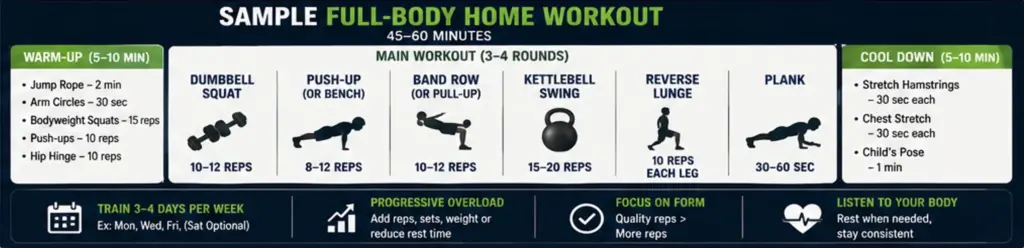
A Sample Full-Body Home Workout You Can Try Today
This session uses five of the seven tools above. It shows what a full body workout at home equipment routine looks like in practice. It takes about 35 to 40 minutes, warm-up and cool-down included.
Warm-up (5 minutes)
- Jump rope: 90 seconds.
- Bodyweight squats: 15 reps.
- Arm circles: 20 seconds each direction.
Circuit (3 rounds, rest 60 to 90 seconds between rounds)
- Dumbbell squats: 12 reps.
- Resistance band rows: 12 reps.
- Kettlebell swings: 15 reps.
- Pull-ups, or band-assisted pull-ups: 8 to 10 reps.
- Plank hold: 30 seconds.
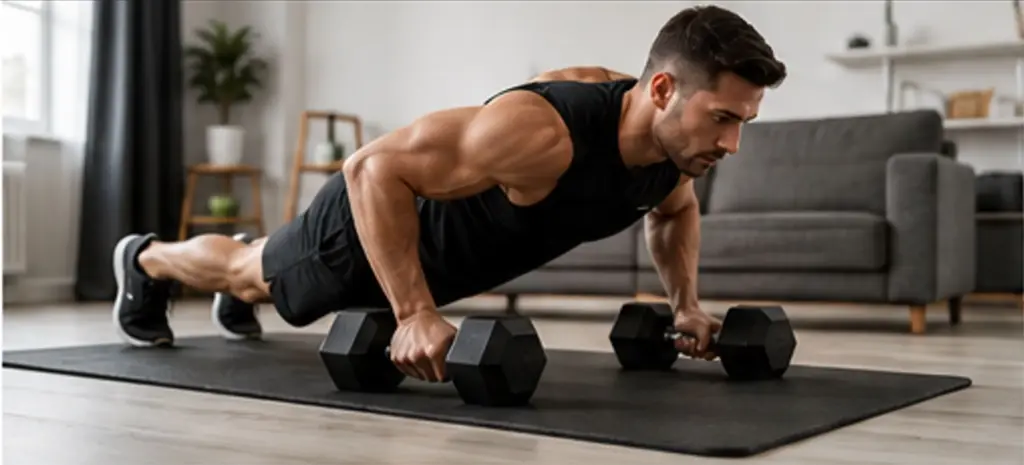
- Push-ups, hands on the stability ball: 10 reps.
Cool-down (5 to 7 minutes)
- Child’s pose stretch: 30 seconds.
- Hamstring stretch: 30 seconds per leg.
- Shoulder cross-body stretch: 20 seconds per arm.
- Cat-cow: 8 slow reps.
Run this three times a week on non-consecutive days. Monday, Wednesday, and Friday work well for most schedules. Leave at least one rest day between sessions.
Progressive Overload: How to Keep Making Gains at Home
Home workouts often stall after a few months. Usually it is not the equipment. It is the lack of a plan to make sessions harder over time.
Progressive overload just means adding more demand on your muscles over time. You can add more weight, more reps, more sets, or less rest between sets. Harvard Health’s recent coverage of resistance training guidance makes a clear point. Home workouts using bodyweight moves and resistance bands can work as well as gym equipment. The biggest gains come from moving off the couch into any steady resistance training at all.
Here is a simple way to apply this at home. If three sets of 10 reps feel easy with a given dumbbell, raise the weight and drop back to 8 reps per set. Work your way back up to 10 over the next few weeks. Aim for two to three sets of 8 to 10 reps per exercise. Stop adding sets past four, since extra volume beyond that mostly adds fatigue, not results.
You do not need to push every set to full failure to make progress. Leaving one or two reps in the tank on most sets gives you enough stimulus for steady gains. Your joints will hold up better over the long run too. That is what keeps a full body workout at home equipment routine working for years, not just months.
Rest, Recovery, and Food That Support Your Training
Equipment and effort only cover part of your results. What you do between sessions matters just as much.
Recovery Between Sessions
Mayo Clinic’s guidance on strength training is clear on rest. Give each muscle group at least 48 hours before you train it again. Lift two to three days a week per muscle group, not daily. Training the same muscles back-to-back without rest does not speed up progress. It usually slows it down, since muscle repair happens during rest, not during the workout itself.
If soreness from your last session changes how you walk or reach overhead, wait one more day before repeating those moves. A short walk or light stretch tends to ease soreness faster than sitting still all day.
Fueling the Muscles You Just Trained
Protein matters more for a full body workout at home equipment routine than most beginners expect. Harvard Health notes that the American College of Sports Medicine has a simple guideline. Aim for 15 to 25 grams of protein within about an hour after a hard workout. That is roughly three to four eggs, or one scoop of protein powder.
You do not need a supplement to hit that number. A glass of milk, a cup of Greek yogurt, or a couple of eggs after training works just as well for most people. For a deeper look at fueling your workouts and meals, this nutrition strategy guide covers timing and food balance in more detail.
Common Mistakes That Slow Progress
A few patterns show up again and again in a full body workout at home equipment routine. Each one is easy to fix once you spot it.
Skipping the warm-up. Jumping into heavy dumbbell squats with cold joints raises your injury risk. Your first set will feel worse than your third. Two or three minutes of light movement fixes this fast.
Never adding weight. Using the same 15-pound dumbbells for a year gives you the same result for a year: no new progress. If 10 reps feel easy for three sets in a row, add weight now.
Training only the muscles you can see. Chest, arms, and abs get the attention, since they show in a mirror. Back, hamstrings, and glutes get skipped. That creates weak spots that can cause posture problems or low-back pain later.
Treating soreness as the goal. Soreness is just a sign of new stimulus, not proof that a workout worked. Chasing soreness every session often means you are training too hard to recover well between sessions.
Skipping rest days. More training is not always better training. Your body adapts and grows during rest. Skip it, and you cap how much progress your training can actually produce.
Frequently Asked Questions
What equipment do I need to start a full body workout at home equipment routine?
A pair of adjustable dumbbells and a set of resistance bands cover most of what a beginner needs for the first few months. Add a pull-up bar, kettlebell, mat, and stability ball as your budget allows.
How many days a week should I train?
Three full-body sessions a week, with a rest day between each, works well for most people balancing training with a job or family. This lines up with the CDC’s advice to do muscle-strengthening activity on at least two non-consecutive days.
Can bodyweight exercises alone replace equipment?
Bodyweight training builds real strength, especially early on. It plateaus faster than loaded training, though, since you cannot easily raise the resistance past your own body weight. Even light dumbbells or bands stretch out how long a bodyweight-based routine keeps working.
How long until I see results?
Strength gains often show up in the first two to four weeks as your nervous system learns the moves. Visible muscle changes usually take eight to twelve weeks of steady training, paired with enough protein and sleep.
Is it normal to feel weaker at home than at a gym?
A bit, especially early on. Machines often stabilize part of a movement for you. Free weights and bodyweight moves can feel harder even at a lower load. That extra stability demand is part of why home training builds real, useful strength.
Do I need a bench for a full-body routine?
No. A stability ball or the floor can stand in for a bench in most pressing moves. A dedicated bench does make some moves, like incline presses, more comfortable if you add one later.
Is a full body workout at home equipment routine enough, or will I eventually need a gym?
For general strength, muscle upkeep, and fat loss, it is enough for most people indefinitely. Only those chasing competitive powerlifting totals or advanced bodybuilding volume tend to outgrow what a well-equipped home setup can offer.
Final Thoughts on Your Full Body Workout at Home Equipment Routine
A full body workout at home equipment routine works because it clears away two big blocks to steady training: time and access. Seven simple tools can do the job. Add overload, rest, and protein, and the results hold up against most gym routines.
Start with two or three tools instead of buying everything at once. Learn the core moves well. Add load slowly. Give your muscles the 48 hours they need to actually grow between sessions. Ready to go further? Building out a proper fit home gym is a natural next step once these basics feel automatic.
Not medical advice: This content, and any calculator results on this site, are for general informational purposes only and are not a substitute for professional medical advice, diagnosis, or treatment. Always talk to a qualified healthcare provider before starting a new diet, exercise routine, or health program.
Related Articles You May Like