Building real muscle takes more than a gym membership and good intent. The essentials of strength training and conditioning are the small set of rules that mark the line between steady, real progress and months of wasted work. Get them right, and your body responds. Get them wrong, and you can train hard for a year and barely change.
This guide breaks down ten essentials of strength training and conditioning that truly move the needle: how to load your muscles, how to eat, how to rest, and how to dodge the errors that quietly stall growth. Every point here comes from solid exercise science, not gym myths.

Table of Contents
What Are the Essentials of Strength Training and Conditioning?
Strength work uses load, be it weights, bands, machines, or your own body weight, to push muscles past what they are used to. That load causes small tears in the muscle fibers. While you rest, your body fixes those fibers and makes them bigger and stronger. This repair cycle is why muscle grows at all.
Conditioning is the other half. It covers your heart and lung fitness, your muscle stamina, and how fast you bounce back between sets and workouts. A lifter with good stamina can do more real work in less time. That means more growth per session.
Beyond looks, this mix pays off in real health terms too. Strength work helps build and hold onto muscle, and it also makes bone denser, since strong muscles tug on bone hard enough to build it up over time. It aids your metabolism as well, and it guards your joints, since strong muscles soak up force that would otherwise land right on your cartilage.
Skip conditioning, and you’ll run out of gas halfway through a workout, cutting your real training short. Skip strength work, and you’ll build decent stamina but little muscle you can see. The essentials of strength training and conditioning work as one system, not as boxes to tick off on their own.
The Rule of Progressive Overload
Progressive overload is the single biggest idea in strength work. It means your muscles need a bit more of a push over time: more weight, more reps, more sets, or less rest between sets. Without that added push, your body has no reason to keep changing.
Muscle does not grow just because you showed up. It grows because you asked your body to do something it could not quite do the week before. This one rule sits at the heart of every plan built around the essentials of strength training and conditioning.
How to Apply Progressive Overload Without Guessing
- Add weight step by step. Once you can finish every set with clean form, add about 2.5 to 5 percent to upper-body lifts and 5 to 10 percent to lower-body lifts.
- Add reps first. Push for one or two more reps at your current weight before you bump the load. This tends to work better over time than jumping weight every session.
- Cut rest time with care. Trimming rest from 90 seconds to 60 seconds builds work rate and stamina, but only once your strength gains start to slow, not before.
- Log every session. If you do not write down your numbers, you are guessing at progress, not tracking it.
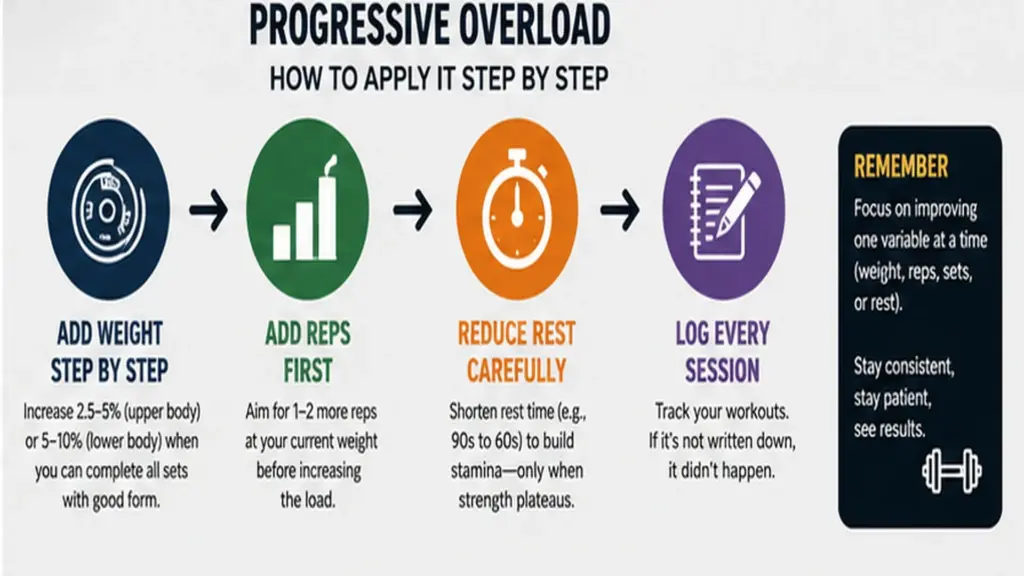
A common slip is trying to push weight, reps, and sets all in the same week. Pick one to push and hold the rest steady. This keeps your joints safe and your progress easy to see.

Big Lifts vs. Small Lifts: Building Your Base
Every strength plan comes down to two kinds of moves.
Big lifts, also called compound moves, work several muscles and joints at once. Squats, deadlifts, bench presses, and rows are the top examples. Since they call on more total muscle, they let you lift heavier loads and spark a bigger response per session than small moves can.
Small lifts, also called isolation moves, target just one muscle and one joint. Bicep curls, leg extensions, and side raises fall in this group. They build size and strength less well than big lifts on their own, but they help fix weak points and finish off a muscle that needs extra work.
Neither type replaces the other. A smart plan builds around big lifts first and fills the gaps with small ones.
| Day | Big Lift | Small-Lift Finisher |
|---|---|---|
| Day 1 | Back squat (legs, core) | Leg extension (quads) |
| Day 2 | Deadlift (back, hamstrings) | Leg curl (hamstrings) |
| Day 3 | Bench press (chest, shoulders) | Tricep pressdown (arms) |
| Day 4 | Barbell row (back, biceps) | Bicep curl (arms) |
If your back day feels thin, a few dumbbell back exercises for strength and definition can round out your pulling work without a barbell. Mixing big and small lifts this way is one of the quiet essentials of strength training and conditioning that new lifters tend to miss.
How Often Should You Train Each Muscle?
The CDC recommends that adults do muscle-strengthening work on two or more days a week, hitting all major muscle groups. That is the base health goal. For real size gains, most lifters see better results when they hit each muscle twice a week rather than once, since it spreads the growth signal more evenly across the week.
A simple split that fits most weeks:
- Day 1: Upper body push and pull
- Day 2: Lower body and core
- Day 3: Rest or light cardio
- Day 4: Upper body, other angles
- Day 5: Lower body, other angles
- Days 6 and 7: Light rest or full rest
New lifters often do better with full-body days three times a week rather than a split plan, since full-body work naturally hits each muscle twice a week with less to plan. If gym time is short, a full body workout at home equipment guide can help you build a solid plan with little gear. Getting this frequency right is one of the essentials of strength training and conditioning that shapes how fast the rest of the plan pays off.
Food: Fueling the Essentials of Strength Training and Conditioning
No plan beats a poor diet. Muscle repair needs raw fuel, and that fuel comes from food, not a bottle.
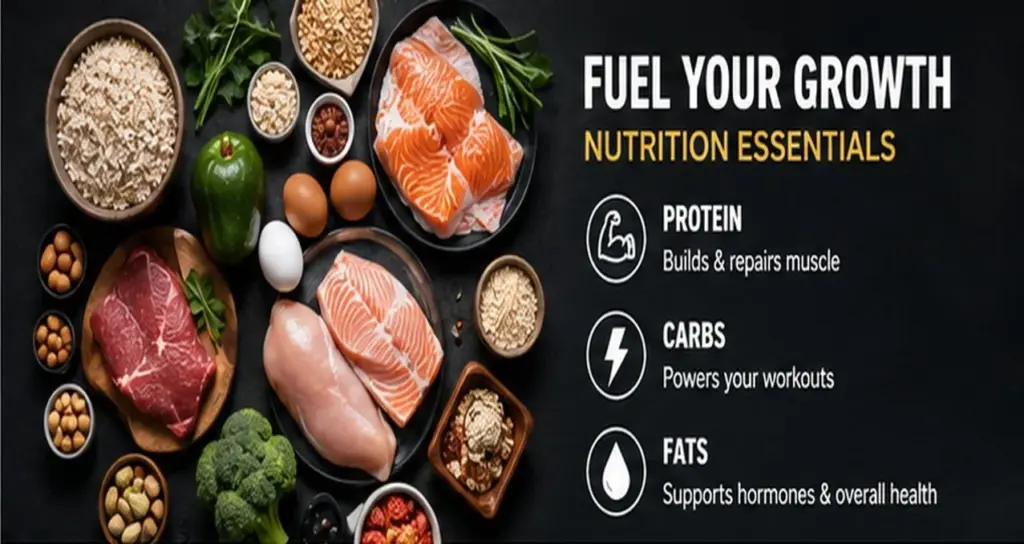
Protein: The Building Block
Sports nutrition research puts the useful protein range for building and holding onto muscle at about 1.4 to 2.0 grams per kilo of body weight each day for most active adults. Many lifters aim a bit higher, closer to 2.2 grams per kilo, mainly when cutting calories and trying to protect muscle they already have. Going well past this range rarely adds much, so more protein is not always better once you are already in the useful zone.
Carbs: Your Training Fuel
Carbs refill muscle glycogen, the fuel your muscles burn during hard lifts. Oats, rice, potatoes, and fruit are solid picks. Cut carbs too hard while lifting heavy, and your workouts often start to feel flat and weak within a week or two.
Fat: Often Overlooked
Fat in your diet helps your body make hormones, including testosterone, which plays a part in muscle repair. Foods like olive oil, avocado, nuts, and fatty fish also help your joints, which matters when you load them under heavy weight week after week. Getting all three macros right is where the essentials of strength training and conditioning meet your kitchen, not just your gym bag.
A simple daily plate might look like eggs and oats at breakfast, chicken with rice at lunch, and salmon with sweet potato at dinner, plus Greek yogurt or a shake to close any protein gap. If you would rather work with exact numbers than guess, a macro calculator maps protein, carbs, and fat to your body weight and goals. For a wider look at building eating habits that last, this nutrition strategy for lasting health and energy covers the basics in more depth.
Rest and Recovery: The Most Skipped Essential
Training breaks muscle down. Rest is what builds it back up, and skipping this step is one of the fastest ways to stall growth or get hurt.
Sleep is the biggest lever you have. Most adults need 7 to 9 hours a night, since a big share of muscle repair and growth hormone release happens during deep sleep. Cut sleep short, and you do not just slow your recovery; you also raise your odds of injury next time you train.
Fluid intake matters more than most lifters think. General guidance from Mayo Clinic points to a range of about 2.7 to 3.7 liters of total fluid a day for healthy adults, counting water from food as well as drinks, and that number climbs with heavy sweat or hot training rooms. A fluid loss of just 2 percent of body weight can measurably cut your strength output.
Light stretching, a walk, or easy mobility work on rest days keeps blood moving to sore muscles without adding fatigue. It is not a must, but most people bounce back a bit faster with it in the mix.

Conditioning: Why Cardio Still Matters for Lifters
Conditioning is not the enemy of muscle growth. It is what lets you train hard enough, week after week, to build it in the first place, which is exactly why it earns a spot among the essentials of strength training and conditioning rather than sitting off to the side. Weak stamina shows up as running out of steam on set three of five, which quietly caps how much real work you get done.
Two paths work well next to lifting:
- Short, hard intervals (10 to 20 minutes) build work rate without eating much into your recovery time.
- Steady, easy cardio, like walking or a bike ride, aids fat loss and heart health without getting in the way of strength gains.
If you want a blend of both, dumbbell HIIT workouts for fat loss and strength mix load and stamina work in one session, which is a good fit when time is tight.
Tracking Progress the Right Way
What you do not measure, you cannot manage. Loose goals like “get stronger” rarely survive a busy month, but real numbers do, which is why tracking earns its place on any true list of the essentials of strength training and conditioning.
Worth tracking:
- Weight and reps on your main lifts, session by session
- Body measures, like waist, arms, and thighs, every 4 to 6 weeks, not each day
- How hard a session felt, on a 1-to-10 scale, to catch overtraining early
- Photos taken in the same light once a month, since a mirror lies more than a camera does
The number on the scale is the least useful of all. Muscle and water weight shift each day for reasons that have nothing to do with real progress.
Do You Need Supplements?
Supplements back up a good diet; they do not replace one, and they sit near the bottom of any honest list of what matters most. That said, a few do have solid proof behind them.
Whey protein gives you an easy way to close a protein gap, mainly right after training when a full meal is not on hand.
Creatine is one of the most studied aids for strength, muscle size, and output, and proof shows it is safe when used as told. A steady dose of 3 to 5 grams a day, taken each day, works about as well as a loading phase for most people.
BCAAs are the one aid that gets oversold. If you already eat enough total protein from whole food or whey, you get all the key amino acids, BCAAs included, in the mix your body already uses. Extra BCAAs on top of a full protein intake add little for most lifters, no matter what the label promises.
Common Mistakes That Slow Down Muscle Growth
Even lifters who know the essentials of strength training and conditioning fall into these traps.
- Chasing soreness. Feeling sore does not mean a workout worked, and no soreness does not mean it failed. Real progress shows up in your numbers, not your aches.
- Skipping warm-ups. Two or three light sets before your work weight get your joints ready and cut injury risk, most of all on heavy leg days.
- Copying someone else’s plan word for word. What suits a lifter with five years of work rarely suits a new lifter’s rest needs or skill level.
- Training through pain. Soreness and pain are not the same thing. Pain that changes how you move calls for rest, not a heavier set.
- Trading form for weight. A heavier lift done wrong builds bad habits faster than it builds muscle.
Most of these slips are easy to fix once you spot them, which is why a quick self-check against the essentials of strength training and conditioning every few weeks is worth the ten minutes it takes.
Frequently Asked Questions
What are the essentials of strength training and conditioning?
They come down to six moving parts: progressive overload, smart move choice, solid training frequency, real food, true rest, and stamina work. Miss more than one, and progress slows even if you train hard.
How long before I see real muscle growth?
Most new lifters feel strength gains within 2 to 4 weeks and see size change by 8 to 12 weeks, as long as training, food, and sleep stay fairly steady. Genes and where you start shift this timeline both ways.
Can I build muscle without lifting heavy?
Yes, up to a point. Studies show mid-range loads taken close to failure can build muscle size close to what heavy loads build. Heavy weight still tends to build raw strength faster, though.
Will cardio get in the way of my muscle gains?
Not at a fair amount. Two or three sessions a week, kept apart from your hardest lift days, tend to aid recovery and heart health without cutting into muscle growth.
Do I need a rest day between every workout?
Not always. What counts is that each muscle gets close to 48 hours before it works hard again, not that each and every day is a full rest day. Getting this balance right is one of the smaller essentials of strength training and conditioning, but it adds up fast over a full training year.
Conclusion: Putting the Essentials of Strength Training and Conditioning Together
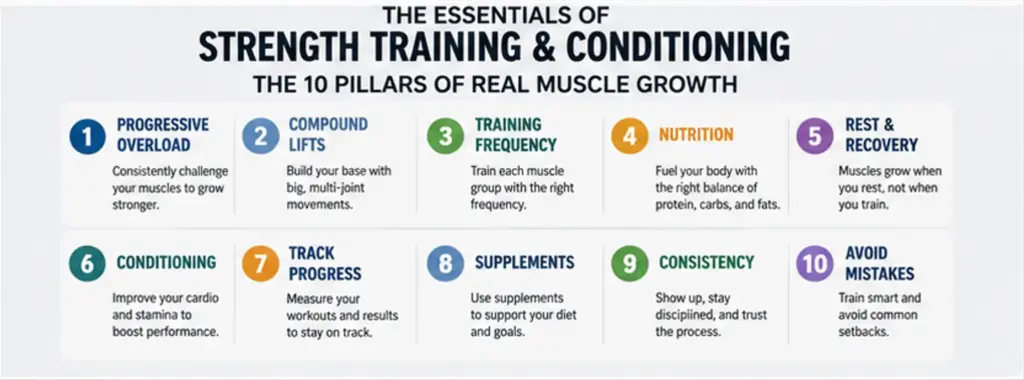
None of these ten essentials work alone. Progressive overload with poor food falls flat. Great food with no rest leads to burnout. Stamina work with no strength work leaves you fit but not strong.
Treat the essentials of strength training and conditioning as one linked system: load your muscles a bit more each week, eat and sleep like rest truly matters, and track what you do. The results follow on a fairly steady timeline. Most people do not need a fancier plan than that. They just need to run this one, week after week.
Not medical advice: This content, and any calculator results on this site, are for general informational purposes only and are not a substitute for professional medical advice, diagnosis, or treatment. Always talk to a qualified healthcare provider before starting a new diet, exercise routine, or health program.
Related Articles You May Like