Search “Boost energy drink,” and you’ll find two very different products. One is a shake sold near the vitamins at your pharmacy. The other is a fizzy can sold at UK gas stations.
This mix-up trips up a lot of shoppers. Most articles never explain why it happens. This guide clears it up. You’ll learn what’s really inside Boost Energy Drink. You’ll also see who it’s made for, and how it compares to a real energy drink.
Table of Contents
What Is Boost Energy Drink, Really?
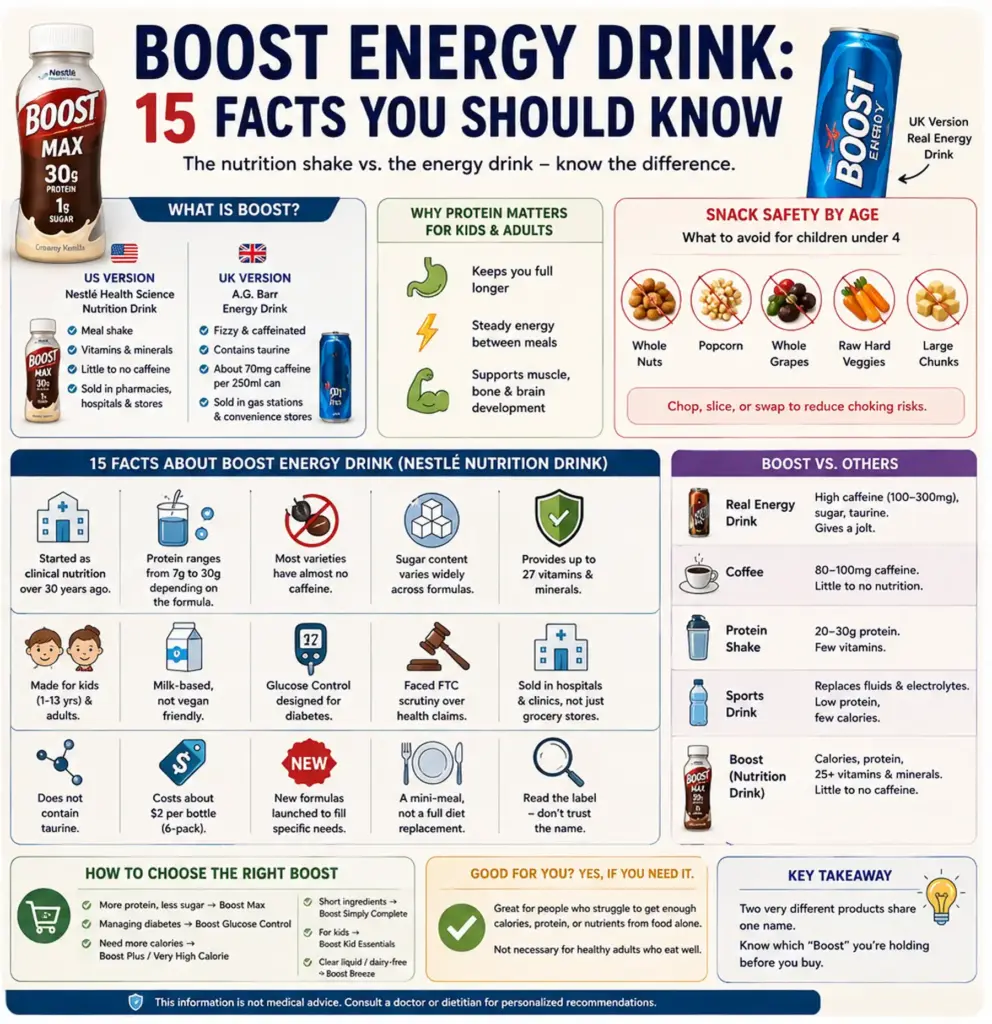
In the US, Boost is a nutrition drink made by Nestlé Health Science. It’s a meal-shake built for people who need extra calories or protein. You’ll find it near Ensure, not near Red Bull.
In the UK and Ireland, a different company makes a real energy drink called Boost. It’s fizzy. It has taurine. It sits next to Monster and Red Bull on the shelf. A company called A.G. Barr owns this UK brand now.
These two drinks share a name. That’s about all they share. One site that tracks caffeine content even warns shoppers not to mix them up. Most people who search this exact phrase mean the Nestlé shake. So that’s our main focus here. We’ll still compare it to a real energy drink further down.
15 Facts About Boost Energy Drink
Here’s what stands out once you look past the name.
1. It Started as Clinical Nutrition, Not a Drink Brand
Nestlé Health Science has sold Boost for more than 30 years. It didn’t start as a drink for the road. It started as a way to help people get enough calories and protein. Food alone wasn’t always enough.
That clinical start still shapes the product today. Boost is sold in hospitals and clinics, not just grocery stores.
2. Protein Ranges From 7 to 30 Grams, Depending on the Bottle
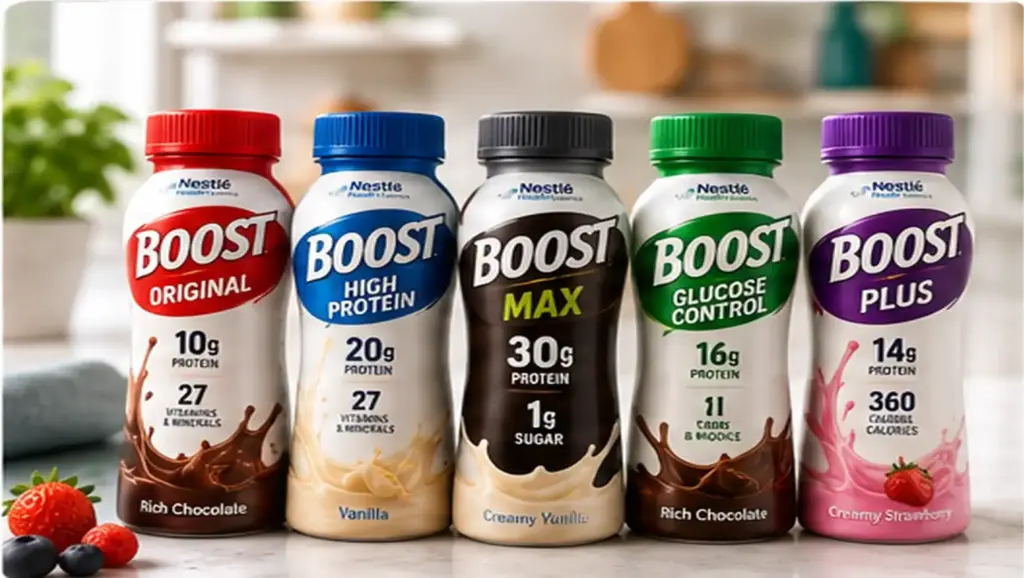
“Boost” isn’t just one drink. It’s a lineup of more than ten formulas. Protein content changes a lot between them.
| Product | Calories | Protein | Best For |
|---|---|---|---|
| Boost Original | 240 | 10g | Everyday extra nutrition |
| Boost High Protein | 250 | 20g | More protein, same calories |
| Boost Max | 160 | 30g | Max protein, low sugar |
| Boost Plus | 360 | 14g | Gaining or holding weight |
| Boost Very High Calorie | 530 | 22g | Big weight-gain needs |
| Boost Glucose Control | 190 | 16g | Diabetes-friendly nutrition |
| Boost Simply Complete | 190 | 10g | A short ingredient list |
| Boost Breeze | 250 | 9g | Clear, dairy-free diets |
| Boost Kid Essentials 1.0 | 240 | 7g | Children ages 1 to 13 |
Grabbing the wrong bottle is easy to do. Always check the label. Don’t assume every Boost drink offers the same nutrition.
3. Most Varieties Have Almost No Caffeine
This is where the “energy drink” name breaks down. Nestlé’s Boost isn’t made with added caffeine at all.
Chocolate flavors pick up a tiny bit from the cocoa itself. That’s often under 5 milligrams per bottle. It’s a small fraction of what you’d get from a real energy drink. Even a cup of tea has more. Curious about cocoa and caffeine? Our guide on whether dark chocolate has caffeine explains why cocoa alone won’t give you a real buzz. If you want a jolt, Boost won’t give you one.
4. Sugar Content Swings Widely Across the Lineup
Sugar changes a lot depending on which formula you pick:
- Boost Max: 1 gram of sugar
- Boost Plus: 4 grams of sugar
- Boost Glucose Control: 4 grams of sugar (16 grams of total carbs)
- Boost High Protein: about 11 grams of added sugar, depending on flavor
Boost Original actually uses two sweeteners, not one. It blends cane sugar with stevia leaf extract. That’s worth knowing if you assumed it was either full sugar or fully artificial. It’s really both, plus a natural, calorie-free sweetener on top.
5. One Bottle Can Deliver Up to 27 Vitamins and Minerals
Most Boost formulas pack in 25 to 27 vitamins and minerals per bottle. That includes calcium and vitamin D for your bones. It also includes vitamin C, zinc, iron, and selenium for your immune system. Want a broader daily lineup? See our list of the best daily vitamins for men for comparison.
This part of the “energy” claim holds up. B-vitamins help your body turn food into usable energy at the cell level. That’s a different job than the jolt caffeine gives you. Both just happen to get marketed as “energy.”
6. It’s Made for a Surprisingly Wide Age Range, Including Kids
A common myth says Boost is strictly for adults. That’s not true. Nestlé makes Boost Kid Essentials just for children ages 1 to 13. There’s a standard version, plus a richer 1.5 version for kids who need more nutrition in less liquid.
Kid Essentials includes a nutrient blend the company calls CalciLock, meant to support strong bones. Kids can drink it, or take it through a feeding tube, with a doctor’s help. At the other end of the age range, older adults use Boost too. It often helps with a small appetite, or weight loss they didn’t plan for. For more ideas along these lines, check out these high-protein snacks for kids.
7. It’s Milk-Based, So It’s Not Vegan-Friendly
Milk protein concentrate is the base of nearly every Boost formula. That’s what gives it a creamy texture. It’s also what rules the product out for a vegan diet.
Standard Boost drinks work fine for lactose intolerance. The lactose gets taken out when it’s made. They’re not suitable for galactosemia, a rare condition. One clear exception stands out: Boost Breeze. It’s clear, dairy-free, and built for clear liquid diets. It’s often used around certain medical procedures.
8. Boost Glucose Control Was Built for People Managing Diabetes
Boost Glucose Control isn’t just a lower-sugar version of the regular drink. It’s a different mix: 190 calories, 16 grams of protein, and 16 grams of carbs per bottle. That equals one “carb choice” under standard diabetes meal planning.
Nestlé says it’s shown in trials to cause a smaller blood sugar rise than a standard nutrition drink. This applies to people with type 2 diabetes. That’s a real claim, but it comes with a catch. It’s not a substitute for medication. It’s meant to be one part of a diabetes plan, guided by a doctor. Curious why carb counts matter so much? The CDC’s guide to carb counting explains it clearly.
9. The Brand Has Faced Regulatory Scrutiny Over Its Claims
In 2010, the FTC settled with Nestlé over ads for Boost Kid Essentials. The company had claimed the drink could cut school absences and shorten diarrhea in kids. Nestlé agreed to stop making those claims unless real clinical studies backed them up. No fine was paid, and no wrongdoing was admitted.
It’s a useful reminder for any nutrition product, not just this one. Marketing claims and clinical proof don’t always move at the same speed. A healthy dose of doubt toward big health claims is often smart.
10. It Shows Up in Hospitals, Not Just Grocery Stores
Boost belongs to a clinical group called oral nutrition supplements, or ONS. Dietitians often recommend products in this group. That includes patients who are underfed, healing from surgery, or unable to eat enough alone.
Nestlé Health Science markets a whole hospital version of the Boost lineup. It goes straight to hospitals, nursing homes, and doctors. That’s a very different path than a normal energy drink brand takes. It says a lot about the real job this product is built to do.
11. It Skips Taurine Entirely
Real energy drinks, including the UK’s Boost lineup, almost always pair taurine with caffeine. Nestlé’s Boost skips taurine completely. Its protein comes from milk protein concentrate, soy protein, and casein instead.
This isn’t a move to look “cleaner” than energy drinks. Boost was never built on an energy-drink formula in the first place. There was never a reason to add taurine at all.
12. A Six-Pack Costs More Than You’d Expect
A six-pack of standard 8-ounce Boost bottles often runs about $10 to $13 at most stores. Price shifts a bit with the formula and any sales. That works out to roughly $2 a bottle, more than a soda or a typical energy drink.
The price reflects what’s actually inside: real protein, calories, and 25-plus vitamins and minerals, not just flavored water. Bigger multi-packs often bring the per-bottle cost down.
13. New Formulas Keep Launching to Fill Specific Gaps
The Boost lineup has grown steadily over the years. Nestlé added a compact bottle size in 2015. Boost Simply Complete arrived in 2016, built from just nine ingredients. In 2018, the company raised the protein in Boost High Protein by a third. It went from 15 grams up to 20.
More recently, Boost Max pushed protein even higher. It hit 30 grams a bottle, while sugar stayed at just 1 gram. Each new formula tends to target one clear need, rather than trying to do everything at once.
14. It’s a Mini-Meal, Not a Full Diet Replacement
Nestlé’s own product pages describe most Boost drinks as a “mini-meal or snack,” not a meal replacement. That difference matters. Living on one drink alone, for the long term, isn’t the plan here. Not without a doctor’s input, anyway.
Some special versions are approved as a main food source, but only under a doctor’s or dietitian’s guidance. For most shoppers, Boost works best next to real meals, not instead of them. For a broader plan, our nutrition strategy tips cover the basics of sustainable eating.
15. Reading the Label Beats Reading the Name
The single best habit here is simple. Check the ingredient panel and nutrition facts, not just the product name. “Boost Energy Drink” could mean a caffeinated soda in Leeds. It could also mean a milk-based shake in Ohio. The two aren’t close to the same thing.
Shopping online or traveling abroad? Check the maker’s name on the label. It’s the fastest way to know which “Boost” you’re actually holding.
Is Boost Energy Drink Actually Good for You?
For the right person, yes. Nestlé’s Boost can really help people who struggle to get enough calories, protein, or nutrients from food alone. That includes older adults with a small appetite. It also includes people healing from surgery or illness, and anyone losing weight without meaning to.
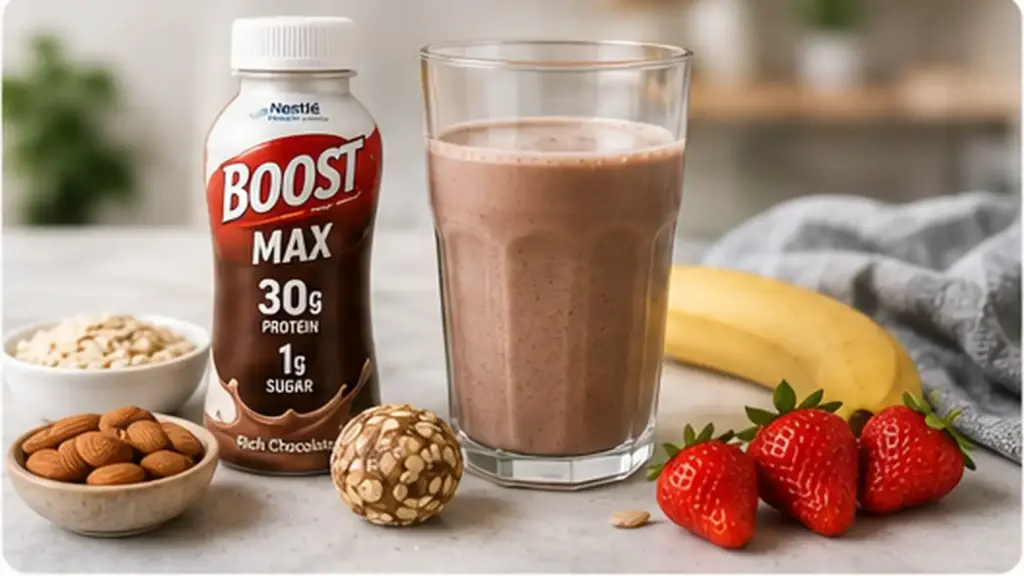
The National Institute on Aging notes that supplements like this work best with a doctor’s help. This matters most for people managing diabetes, kidney disease, or a milk allergy. Some Boost formulas aren’t right for every case.
For a healthy adult who already eats well, Boost isn’t necessary. A little won’t hurt you, but it won’t beat real food for daily nutrition. Mild bloating is possible, especially if you’re not used to dairy protein, or you drink one too fast.
How many bottles make sense in a day depends on the formula and the rest of your diet. That’s worth asking a doctor or dietitian, rather than guessing, especially with kids’ formulas or Glucose Control.
Boost Energy Drink vs. Real Energy Drinks, Coffee, and Protein Shakes
These comparisons only make sense once you split the two Boost products apart.
Versus a real energy drink: A 250ml can of the UK’s Boost has about 70mg of caffeine. That’s close to a cup of coffee. Per Mayo Clinic, most energy drinks pack 100 to 300mg of caffeine per serving. Home-brewed coffee runs about 80 to 100mg a cup. Nestlé’s nutrition drink has almost none of it.
Versus coffee: Coffee gives you caffeine and little else. Nestlé’s Boost gives you calories, protein, and vitamins, with almost no caffeine. They solve two different problems. Neither one was built to replace the other.
Versus a protein shake: A typical protein shake focuses on protein alone. That’s often 20 to 30 grams a serving, with few added vitamins. Boost takes a wider approach, balancing protein with calories and a full vitamin mix. That’s why it’s sold as complete nutrition, not a post-workout add-on. Building a broader high-protein day? Our high-protein meal prep ideas can round out the rest of your meals.
Versus a sports drink like Gatorade: Sports drinks replace salt and fluid lost through sweat during exercise. They aren’t built to give you much protein or many calories. Boost does the opposite. It’s packed with calories and protein, with no real role in hydration.
How to Choose the Right Boost Product
Match your goal to the right formula, instead of grabbing whatever’s on the shelf:
- Want more protein, less sugar: Boost Max (30g protein, 1g sugar)
- Managing diabetes: Boost Glucose Control, with your doctor’s input
- Need more calories to gain or hold weight: Boost Plus or Boost Very High Calorie
- Want a short, simple ingredient list: Boost Simply Complete
- Shopping for a child: Boost Kid Essentials, with a pediatrician’s input
- On a clear liquid or dairy-free diet: Boost Breeze
- Looking for a real caffeine boost: Neither product here is a good daily pick for that. A normal energy drink or coffee will do the job. Stay within the FDA’s daily guidance of up to 400mg for most healthy adults
Frequently Asked Questions About Boost Energy Drink
Is Boost Energy Drink actually an energy drink? Only one version is. The UK’s Boost makes a real fizzy, caffeinated energy drink. The Nestlé version sold in the US is a nutrition shake. It has little to no caffeine, despite the name.
Does Boost Energy Drink have caffeine? The Nestlé drink has almost none. The only exception is a trace amount in chocolate flavors, from the cocoa. The UK energy drink has about 70mg per 250ml can.
Is Boost Energy Drink good for weight loss? Lower-calorie, higher-protein picks like Boost Max can fit into a weight-loss plan. They help you feel full on fewer calories. Think of it as one tool, not a shortcut. Pair it with a full eating plan, rather than relying on it alone.
Can people with diabetes drink Boost Energy Drink? Boost Glucose Control was built just for this. It isn’t a substitute for medication. It works best as one piece of a diabetes plan you build with your doctor or dietitian.
Is Boost Energy Drink vegan? No. Nearly every formula uses milk protein, which rules it out for a vegan diet. Boost Breeze is dairy-free, but it’s made for clear liquid diets, not as a general vegan pick.
How many Boost drinks can I have in a day? There’s no single number that fits every formula or every person. It depends on your full diet and your calorie needs. It also depends on whether you’re using a special formula, like Glucose Control or Kid Essentials. A doctor or dietitian can give you a real target.
Is Boost the same thing as Ensure? No, but they’re close rivals in the same category. Both are milk-based nutrition drinks aimed at similar needs. Nestlé makes Boost, and Abbott makes Ensure. Their calorie and protein ranges are fairly close across each lineup.
Final Thoughts on Boost Energy Drink
The name “Boost Energy Drink” promises something it often doesn’t deliver. In the US, you’re almost certainly holding a nutrition shake. It’s made to add calories, protein, and vitamins to someone’s diet, not to give you a caffeinated pick-me-up.
That doesn’t make it a bad product. It’s just not what the name suggests. It’s built for a clear job: filling real nutrition gaps for people who need it. That could be a child, an older adult, or someone healing from illness. Once you know which “Boost” you’re actually holding, picking the right bottle gets a lot easier.
Not medical advice: This content, and any calculator results on this site, are for general informational purposes only and are not a substitute for professional medical advice, diagnosis, or treatment. Always talk to a qualified healthcare provider before starting a new diet, exercise routine, or health program.
Related Articles You May Like